



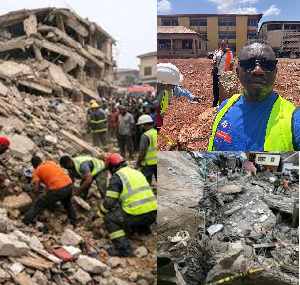
Experts Say Most Structural Failures Are Preventable, Not Accidental
Recent investigations into building collapses across Ghana are painting a troubling picture of a construction industry plagued by recurring mistakes, weak oversight, and disregard for professional standards.
From residential apartments and commercial complexes to educational facilities, a growing body of evidence suggests that many of the country's building failures are not isolated incidents but symptoms of a deeper systemic problem that continues to place lives and investments at risk.
A technical review by construction and infrastructure expert, Engr. Surv. Dr. Ebenezer Ankomah Gyamera, examined several major building collapse incidents and found striking similarities in the causes of the disasters.
Among the most notable cases was the collapse of an unauthorized three-storey building under construction at Klagon in 2025. Investigations revealed the absence of a valid building permit, poor workmanship, weak supervision, deficiencies in concrete works, and the use of substandard materials. The report also found inadequate consideration of soil conditions and foundation requirements before construction commenced.
At West Legon, a roof collapse following a fire outbreak exposed another layer of safety concerns. Investigators identified improper electrical installations, haphazard wiring systems, structural weaknesses within the roof framing, inadequate reinforcement detailing, and poor maintenance practices. The findings raised concerns about safety standards in both the construction and management of occupied buildings.
The 2025 structural failure at Roman Ridge, popularly known as "The Address," further demonstrated the consequences of ignoring technical guidance. According to the report, the collapse occurred during the casting of a podium slab and was linked to undersized temporary support systems, insufficient shoring props, lack of engineering verification, and management decisions that overruled professional advice. Investigators also cited inadequate regulatory review of temporary works.
The findings are not limited to recent cases. The report revisits the 2012 Melcom building collapse, where investigations identified poor concrete quality, inadequate reinforcement detailing, structural overloading, lack of approved structural drawings, and weak supervision during construction. More than a decade later, many of the same issues continue to emerge in contemporary investigations.
Equally concerning is the collapse of the Newtown Basic School building in 2026. The four-storey structure reportedly suffered severe structural deterioration due to years of neglect. Investigators pointed to a lack of maintenance, delayed intervention despite visible warning signs, and weak institutional accountability as key contributors to the disaster.
The report concludes that these incidents reveal a pattern of recurring failures rather than isolated accidents. Across multiple investigations, common factors include construction without permits, poor structural design, absence of qualified professionals, poor workmanship, substandard materials, weak regulatory oversight, inadequate maintenance, and non-compliance with established standards.
Beyond the collapsed structures themselves, the consequences continue to affect individuals, families, businesses, and communities.
The report highlights the devastating human cost, including deaths, injuries, psychological trauma, displacement of families, and loss of livelihoods. Economically, building collapses result in destroyed investments, increased insurance costs, productivity losses, and expensive legal disputes. At the national level, repeated structural failures undermine investor confidence, increase pressure on emergency services, damage Ghana's international image, and erode public trust in institutions responsible for enforcing safety regulations.
In response to the findings, the report proposes a comprehensive roadmap aimed at preventing future tragedies.
Among the key recommendations is the strict enforcement of building regulations, with a zero-tolerance approach to unauthorized construction. The report emphasizes a simple principle: no permit should mean no construction.
The review also calls for the mandatory involvement of registered architects, structural engineers, quantity surveyors, and licensed contractors on medium- and high-risk projects. Experts argue that professional supervision must become the norm rather than the exception.
Additional recommendations include mandatory geotechnical investigations for multi-storey developments, independent structural checking of designs before approval, stronger inspection regimes at critical construction stages, improved testing and certification of building materials, and periodic structural audits for public buildings, schools, hospitals, churches, shopping centres, and high-rise developments.
The report further advocates increased staffing, logistics, digital permitting systems, and stronger enforcement powers for municipal assemblies to improve monitoring and compliance. Public education is also identified as a critical component of prevention, with citizens encouraged to verify permits, engage qualified professionals, report unsafe structures, and avoid unauthorized modifications.
For many observers, the findings serve as a warning that building collapse in Ghana is no longer simply a construction issue. It is a matter of public safety, governance, accountability, and national development.
As investigations continue to reveal similar causes across multiple incidents, experts are urging authorities to shift from reacting to disasters after they occur to preventing them before lives are lost. The report concludes that if the recommended reforms are fully implemented, Ghana can significantly reduce building failures, protect investments, save lives, and restore public confidence in the construction sector.
For full report: neoreportgh.com (https://neoreportgh.com/when-buildings-collapse-families-collapse-too-experts-call-for-urgent-action-on-ghanas-construction-crisis/)

Copyright © 1994 - 2026 GhanaWeb. All rights reserved.










