General News of 2026-09-22
Ghana’s local governance system needs overhaul – Emeritus Prof Ayee
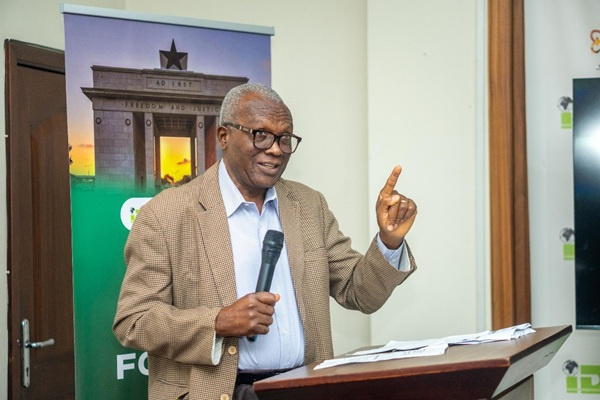 Ghana’s decentralisation system has made some gains, but its architecture remains too weak to deliver meaningful local autonomy, accountability and responsiveness, Emeritus Professor Atsu Ayee has observed.
Prof. Ayee made this call at a Citizens’ Forum organised by the Institute for Democratic Governance (IDEG), in collaboration with Oxfam, under the theme “Constitutional Reform and Democratic Decentralisation in Ghana: The Way Forward for Local Governance.”
Speaking on the topic, “Reforming Decentralisation to Deepen Autonomy, Accountability and Responsiveness in Ghana,” Emeritus Professor Ayee, a seasoned scholar on local governance, acknowledged that Ghana has made progress in establishing the institutional “hardware” of decentralisation, particularly through the creation of Metropolitan, Municipal and District Assemblies (MMDAs). However, a number of persistent challenges continue to undermine the effectiveness of the system.
According to him, over the years, changes in government policies have affected the consistency and sustainability of decentralisation reforms. He stated that at the various MMDAs, Ghana’s decentralisation framework remains “on paper” rather than in practice. The result, he noted, is a system that remains heavily centralised despite its decentralised structure.
Prof. Ayee highlighted the need to move beyond simply maintaining decentralised structures towards a system where local authorities have genuine decision-making powers, adequate resources and stronger accountability to the people they serve.
Create mechanisms to increase women's representation in constitutional reforms – Gender expert
“Meaningful decentralisation will require a fundamental reform of the architecture that governs local power, participation, representation and accountability in Ghana,” he stated.
His remarks come at a critical moment in Ghana’s democratic development, as reforms to the country’s local governance system are being considered under the Constitution Review process initiated by President John Mahama.
It was against this backdrop that the forum brought together citizens, civil society organisations, governance practitioners, researchers, local government actors, political stakeholders and other interested groups to examine the state of Ghana’s decentralisation system and explore reforms needed to make local governance more responsive, accountable and citizen-centred.
BAI
Foundries, Machines and Jet Engines: Ghana’s untapped engineering potential
Ghana’s decentralisation system has made some gains, but its architecture remains too weak to deliver meaningful local autonomy, accountability and responsiveness, Emeritus Professor Atsu Ayee has observed.
Prof. Ayee made this call at a Citizens’ Forum organised by the Institute for Democratic Governance (IDEG), in collaboration with Oxfam, under the theme “Constitutional Reform and Democratic Decentralisation in Ghana: The Way Forward for Local Governance.”
Speaking on the topic, “Reforming Decentralisation to Deepen Autonomy, Accountability and Responsiveness in Ghana,” Emeritus Professor Ayee, a seasoned scholar on local governance, acknowledged that Ghana has made progress in establishing the institutional “hardware” of decentralisation, particularly through the creation of Metropolitan, Municipal and District Assemblies (MMDAs). However, a number of persistent challenges continue to undermine the effectiveness of the system.
According to him, over the years, changes in government policies have affected the consistency and sustainability of decentralisation reforms. He stated that at the various MMDAs, Ghana’s decentralisation framework remains “on paper” rather than in practice. The result, he noted, is a system that remains heavily centralised despite its decentralised structure.
Prof. Ayee highlighted the need to move beyond simply maintaining decentralised structures towards a system where local authorities have genuine decision-making powers, adequate resources and stronger accountability to the people they serve.
Create mechanisms to increase women's representation in constitutional reforms – Gender expert
“Meaningful decentralisation will require a fundamental reform of the architecture that governs local power, participation, representation and accountability in Ghana,” he stated.
His remarks come at a critical moment in Ghana’s democratic development, as reforms to the country’s local governance system are being considered under the Constitution Review process initiated by President John Mahama.
It was against this backdrop that the forum brought together citizens, civil society organisations, governance practitioners, researchers, local government actors, political stakeholders and other interested groups to examine the state of Ghana’s decentralisation system and explore reforms needed to make local governance more responsive, accountable and citizen-centred.
BAI
Foundries, Machines and Jet Engines: Ghana’s untapped engineering potential

