Atewa forest at edge of extinction as illegal mining intensifies - Stakeholders warns
Environmental advocacy groups have warned that the Atewa Range Forest Reserve in Ghana’s Eastern Region is facing a threat from illegal mining, with calls for urgent government action to prevent the destruction of the century-old forest.
The warning was contained in a press statement issued by A Rocha Ghana, Eco Conscious Citizens and the Concerned Citizens of Atewa Landscape on September 14, 2026, which said the forest is “at the edge of extinction” following increasing illegal mining activities and mounting pressure on institutions responsible for its protection.
The groups said their assessment was based on court records, operational reports, Forestry Commission correspondence and documentation from the forest.
According to the statement, the Atewa Forest was gazetted as a protected reserve on January 5, 1926, by the Okyeman State Council under the leadership of Nana Sir Ofori Atta I.
A century later, the groups say, the forest’s survival is being threatened by illegal mining, weak enforcement and delays in prosecuting alleged offenders.
The environmental groups described Atewa as a forest of “irreplaceable value”, noting that it covers approximately 26,300 hectares and rises to more than 800 metres above sea level.
The reserve forms the headwaters of the Ayensu, Densu and Birim rivers, as well as more than 99 streams, making it a critical source of water for millions of Ghanaians.
The groups estimate that more than five million people depend on water systems connected to the forest.
Atewa is also home to significant biodiversity, with the statement citing 239 bird species, 69 mammals, 40 amphibians and 14 reptiles. At least 78 species found in the forest are said to be threatened with global extinction.
The forest is also reported to contain 969 vascular plant species and an estimated 711 butterfly species, representing about 77 per cent of butterfly species recorded in Ghana.
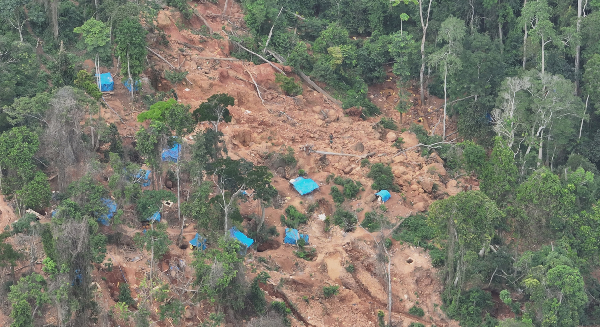
The statement said illegal mining has expanded into parts of the protected reserve, citing the Wankobi Stream headwaters as one of the affected areas.
It described evidence of excavated pits, stripped forest cover, polluted streams, makeshift mining camps and abandoned equipment.
The groups further cited Forestry Commission records indicating that dozens of people had been arrested in connection with illegal mining operations but that the activities continued.
A letter dated March 2, 2026, from the District Manager of the Kyebi Forest District, Owusu Ameyaw, to the Abuakwa South Municipal Chief Executive reportedly stated that 60 people had been arrested in the Sagyimase/Asikam portion of the reserve, yet illegal mining persisted.
The statement also alleged that an operation involving 55 police officers on February 20, 2026, was compromised by an apparent information leak, resulting in only five arrests.
It further reported that two forest guards were allegedly held hostage by illegal miners and later rescued by police reinforcements.
Operations by the National Anti-Illegal Mining Operations Secretariat (NAIMOS) in the Kyebi and Atewa area were also cited, with the groups reporting arrests, the seizure of mining equipment and the destruction of makeshift structures.
The organisations expressed concern about repeated adjournments and bail granted in cases involving alleged illegal miners.
They cited several cases between 2021 and 2026 in which suspects were arrested but proceedings were repeatedly adjourned.
However, the statement acknowledged that convictions had also been secured in some cases, including one in which a suspect was sentenced to 20 years and another involving three suspects who pleaded guilty and received 15-year sentences with hard labour.
The groups said such convictions demonstrate that effective prosecution is possible, although they described them as exceptions rather than the norm.
The environmental groups also highlighted the position of the Okyenhene, who they said has consistently opposed bauxite mining in the Atewa Forest.
At the centenary celebration of the forest’s gazetting on January 5, 2026, the Okyenhene reportedly reaffirmed his commitment to protecting the reserve and questioned how mining could be undertaken without destroying its flora and fauna.
The statement also said court proceedings in 2024 confirmed the Okyenhene’s opposition to bauxite mining in the forest.
Rather than mining, the groups are advocating the development of Atewa as a National Park and the implementation of what they describe as a “Transformational Development Agenda”.
The proposed agenda would focus on eco-tourism, agroforestry, climate finance, green value chains, land restoration and sustainable livelihoods for communities surrounding the forest.
According to the statement, effective protection and restoration of Atewa could generate significant economic benefits, including more than US$5 million annually in tourism revenue and at least 3,000 associated jobs in tourism facilities and services.
The proposal also includes support for cocoa processing and the development of value chains for crops and forest products such as Afromomum, Voacanga, Bitter Cola, Griffonia and avocado.
The groups further identified REDD+, the Green Climate Fund, voluntary carbon markets and Payments for Ecosystem Services as potential sources of climate finance.
The organisations have called on the government to immediately convert the Atewa Range Forest Reserve into a National Park and rescind plans for bauxite mining in the forest.
They are also demanding the deployment of a permanent and well-resourced joint security task force to protect the reserve, increased resources for the Forestry Commission, and faster prosecution of illegal mining cases.
Among other measures, they called for investigations into alleged information leakages and official complicity in illegal mining operations.
They further urged government to establish a dedicated court for illegal mining cases in the Eastern Region and ensure that communities and traditional authorities are actively involved in the protection and development of the forest.
The groups said the government’s 2016 manifesto commitment to convert Atewa into a National Eco-Tourism Park remains unfulfilled.
The organisations said the centenary of the forest’s protection should serve as a reminder of the responsibility of the present generation to preserve the resource for future generations.
They referenced a declaration attributed to Nana Sir Ofori Atta I that land belongs not only to the living but also to those who came before and those yet unborn.
The groups said Atewa’s protection is therefore not only an environmental issue but also a matter of water security, climate resilience, biodiversity conservation, cultural heritage and national development.
They appealed to the President, the Ministry of Lands and Natural Resources, the Forestry Commission, Ghana Police Service, NAIMOS, the Attorney-General and other relevant institutions to act decisively.
“We either deal with this menace or we perish,” the statement said, warning that the loss of the forest could have far-reaching consequences for Ghana’s water resources, environment and future generations.
The statement was signed by A Rocha Ghana, Eco Conscious Citizens and the Concerned Citizens of Atewa Landscape.
AM
“They Were SHOCKED!” Watch Robbery Suspects React as IGP Plays Their Robbery Videos
Source: www.ghanaweb.com« Previous |
Next »