Over 80% of gold programme losses were accounting-related – BoG Governor
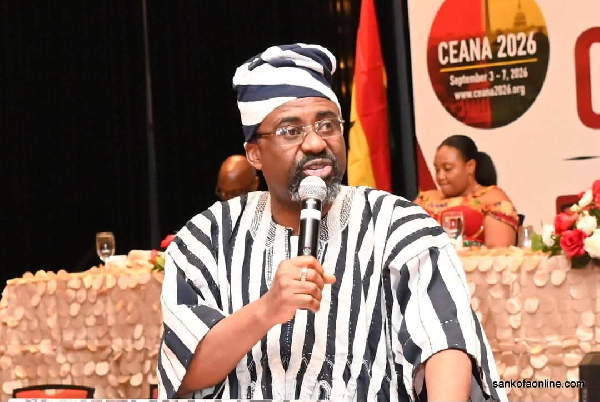
The Governor of the Bank of Ghana (BoG), Dr Johnson Pandit Asiama, has explained that more than 80% of the losses reported under the country’s gold programme were the result of accounting treatment and did not represent missing gold or operational leakages.
He said the losses arose from differences in the exchange rates used to acquire and record the gold, rather than the disappearance of gold or funds through operational weaknesses.
Dr Asiama explained that gold was acquired domestically at the market exchange rate experienced by sellers and other market participants, while the transactions were recorded using the Bank of Ghana’s reference exchange rate.
“The difference appeared in the accounts as a loss. It did not mean that gold had disappeared or that the amount represented operational leakage,” he said.
The Governor made the clarification in a keynote address at the 2026 Convention of the Council of Ewe Associations of North America (CEANA) in Maryland, where he spoke on the theme, “From Sending Home to Building Home.”
He said the losses associated with the gold programme needed to be understood within the accounting framework under which the transactions were recorded.
According to Dr Asiama, the programme had nevertheless contributed to the accumulation of Ghana’s reserves and helped create more orderly conditions in the foreign exchange market.
He said the task going forward was to preserve those benefits while improving the efficiency and transparency of the framework.
Dr Asiama’s comments formed part of his broader assessment of Ghana’s economic recovery, which he said had resulted in improvements in several key economic indicators.
He told Ghanaians in the diaspora that inflation, which had reached 54.1% at the height of the economic crisis, had declined to 5.0% in August 2026.
The economy, he added, grew by 6.4% in the first quarter of 2026, while gross international reserves stood at US$12.9 billion at the end of June, equivalent to about five months of import cover.
He also said the BoG’s policy rate had fallen from 28% in March 2025 to 14%, reflecting improved economic conditions and increased confidence.
Dr Asiama, however, cautioned that economic stability should not be considered the final destination but rather a foundation for households and businesses to plan, invest, create jobs and build for the future.
He said the BoG’s priorities included protecting price stability, strengthening reserve buffers, deepening the foreign exchange market and maintaining a sound and well-governed financial system.
The Governor also highlighted developments in private-sector credit, saying real private-sector credit grew by 34.1% year-on-year in June.
He said Ghana needed not only faster credit growth but also quality, longer-term financing to enable businesses to establish factories, expand exports and invest in technology.
Dr Asiama said the BoG did not determine which businesses banks should lend to but was responsible for creating conditions that support longer-term lending.
He identified predictable inflation, sound banks, improved credit information, deeper financial markets and disciplined underwriting as important conditions for productive credit.
He said the improvements in the economy had come through difficult policy choices and greater discipline but stressed that the gains needed to be sustained.
Dr Asiama also urged Ghanaians abroad to look beyond short-term financial support and participate more directly in Ghana’s development.
He said while remittances remained important to households and the country’s external position, the wider objective should be to create an environment where savings, investment, enterprise and professional expertise could contribute to sustainable development.
He said Ghana needed financial, human and social capital from Ghanaians at home and abroad to build a stronger economy.
The Governor said the BoG would continue to strengthen the financial system and create conditions for sustainable investment while encouraging Ghanaians in the diaspora to explore more long-term ways of contributing to national development.
Source: Desmond Tinana, Contributor
« Previous |
Next »