Asiedu Nketiah assumes leadership of APPI
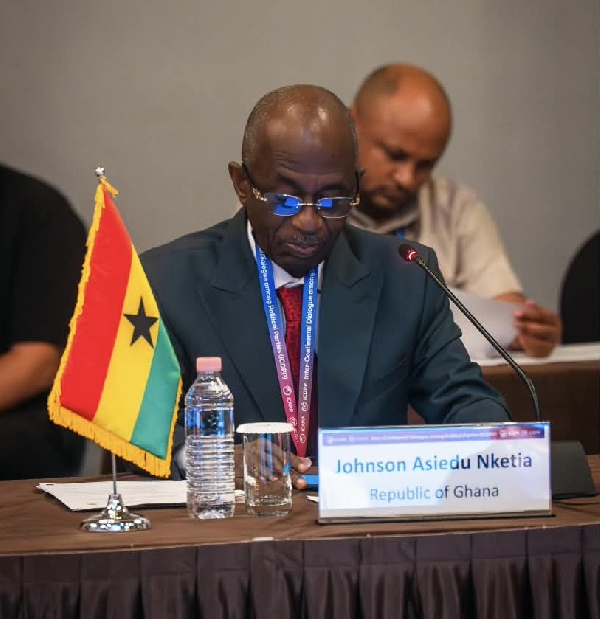
Johnson Asiedu Nketiah, National Chairman of Ghana’s National Democratic Congress (NDC), has officially accepted his new role as Chair of the Africa Political Parties Initiative (APPI).
In his acceptance address, Johnson Asiedu Nketiah expressed deep gratitude to the participating political parties and paid tribute to the Africa Governance Centre for establishing the APPI platform, which brings together political leaders from across the continent.
With leadership now formally constituted, Asiedu Nketiah emphasized that the focus must pivot from formation to action.
Highlighting the cyclical nature of democratic politics,Asiedu Nketiah reminded his colleagues that power is transient. "Political experience teaches us that power changes hands more quickly than nations change," he remarked. "Those who govern today may sit in opposition tomorrow, and those in opposition may later inherit the institutions they once criticised."
Johnson Asiedu Nketiah argued that a political party's mandate extends far beyond merely winning elections. He noted that internal party dynamics such as whether evidence matters, competence is respected, and institutions are taken seriously inevitably bleed into the state apparatus when a party takes power.
Preparing for a Transformed Africa
A central theme of Johnson Asiedu Nketiah’s address was the urgent need for African political structures to modernize in the face of staggering demographic and economic shifts. By 2050, Africa’s population is projected to reach 2.5 billion. While 10 to 12 million young Africans enter the labor market annually, only about 3 million formal jobs are currently created, and the continent still accounts for roughly 2 percent of global manufacturing value-added.
Coupled with the rise of artificial intelligence, shifting energy systems, and intensifying global competition for strategic minerals and technology, Asiedu Nketiah warned that African politics cannot rely on "assumptions inherited from another age."
While acknowledging Africa's vast natural resources, growing markets, and young population, Johnson Asiedu Nketiah stressed that numbers and resources alone do not translate to power or prosperity. "Countries become stronger when they acquire the capability to produce, to finance, to innovate, to organise and to sustain national purpose over time," he said.
The Vision for APPI Agenda 2040
To address these challenges, Johnson Asiedu Nketiah announced the development of APPI Agenda 2040. Designed and shaped by African political parties themselves, the initiative aims to establish a common horizon for institutional reform, capability building, and leadership preparation over the next 15 years.
Johnson Asiedu Nketiah called for a reinvigoration of internal party institutions, including party schools, research institutes, and mechanisms for preserving institutional memory. He also emphasized the necessity of integrating women and young people into policy formulation and resource allocation, rather than restricting their roles to political mobilization.
Furthermore, Asiedu Nketiah cautioned against the disruptive cycles often seen during political transitions. While acknowledging the right of new governments to alter failed policies, he warned that countries pay a heavy price when transitions discard useful expertise, weaken functioning institutions, or abandon long-term national investments. "Political maturity includes the ability to know what must change and what must be preserved. There is no virtue in wasting what works," he stated.
As APPI moves forward, its leadership plans to work closely with party presidents, chairpersons, secretaries-general, regional vice chairs, and the Africa Governance Centre. The initiative will also continue to engage with political counterparts globally, positioning African political history spanning liberation movements, democratic transitions, and economic crisis management as a vital contribution to global political discourse.
"By 2040, Africa will be larger, more urban, more connected and more exposed," Johnson Asiedu Nketiah concluded. "Our responsibility is to ensure that when that moment comes, it inherits institutions equal to the demands it will face."
Source: Eric Obeng Boateng, Contributor
« Previous |
Next »