Ghana calls for bankable projects under China-Africa climate partnership
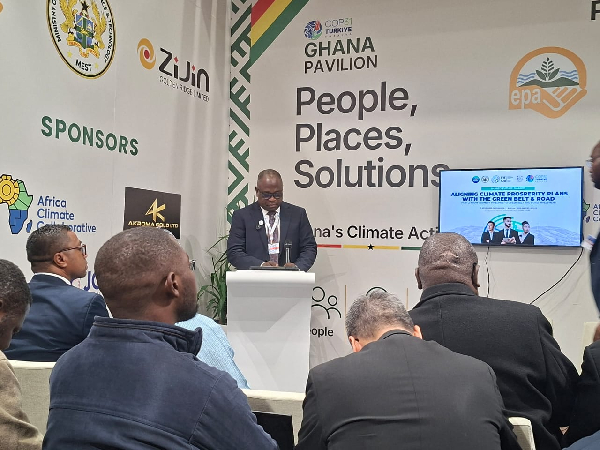
Ghana has called on China and other development partners to translate their climate commitments into bankable projects, increased investment and job creation, arguing that climate cooperation must deliver tangible economic benefits for African countries.
The Minister of State for Climate Change and Sustainability Issifu Seidu said Africa must move beyond securing climate finance pledges and focus on developing credible investment pipelines that can attract funding, technology and implementation partners.
Delivering the welcome and opening remarks at a high-level engagement at the Ghana Pavilion during COP31 in Antalya, Türkiye, on Wednesday, November 11, 2026, the minister said stronger cooperation between Africa and China presented significant opportunities for renewable energy, climate-resilient infrastructure, sustainable industrialisation and green technology.
The engagement, held under the theme “Shared Future, Shared Prosperity: Aligning Climate Prosperity Plans with the Green Belt and Road”, focused on operationalising the Forum on China-Africa Cooperation (FOCAC) through country investment pipelines.
The minister welcomed China's commitment under the FOCAC Beijing Action Plan for 2025-2027 to support 30 clean energy and green development projects across Africa.
However, the minister stressed that the success of the partnership would depend on how effectively the commitments were translated into actual projects and development outcomes.
“We welcome this commitment. However, the true measure of our partnership must be our ability to translate these commitments into bankable projects, mobilized finance, and tangible development outcomes,” the minister stated.
With the current FOCAC Action Plan approaching its final year, the minister said there was an urgent need to accelerate implementation and ensure that commitments made by development partners resulted in investments on the ground.
The minister identified Country Platforms and Climate Prosperity Plans as important mechanisms for identifying national development priorities, developing credible investment pipelines and connecting projects with financing and technical partners.
The minister further called for African countries to ensure that investments under the Green Belt and Road Initiative reflect their development priorities, strengthen local capacities and deliver lasting benefits to their populations.
Highlighting Ghana's approach to climate action, the minister said the country viewed climate investment as an opportunity to accelerate industrialisation, create decent jobs, strengthen energy security and build a resilient economy.
“For Ghana, climate action is not charity; it is a strategic investment in our future. It is an opportunity to accelerate industrialization, create decent jobs, strengthen energy security and build a resilient and prosperous economy,” the minister said.
The minister noted that President John Dramani Mahama had established a dedicated Office of the Minister of State for Climate Change and Sustainability to strengthen leadership and coordination of climate action across government.
Ghana is also pursuing its climate commitments through its Nationally Determined Contributions (NDCs), the National Green Finance Taxonomy and efforts to strengthen institutional coordination and mobilise climate finance.
The minister said Ghana's Climate Prosperity Plan provided a framework for aligning climate ambitions with investment opportunities, while emphasising that affordable financing and debt sustainability remained critical to the development aspirations of climate-vulnerable countries.
Ghana also highlighted its role as host of the headquarters of the Climate Vulnerable Forum and V20 (CVF-V20), an alliance representing climate-vulnerable economies across Africa, Asia, the Caribbean and the Pacific.
The minister also urged stakeholders involved in the partnership between the CVF-V20 and the Belt and Road Initiative International Green Development Coalition to prioritise practical results.
According to the minister, the success of the cooperation should be measured by the projects developed, investments mobilised, jobs created and resilience built within communities.
The minister also emphasised the need for African countries to remain at the centre of defining and driving their development priorities.
“Above all, let us ensure that African countries remain at the center of defining and driving their own development pathways,” the minister stated.
Story by Mawuli Ahorlumegah reporting from the United Nations Climate Change Conference COP31, Antalya, Türkiye
Source: www.ghanaweb.com« Previous |
Next »