5 African business giants who stepped back from their companies
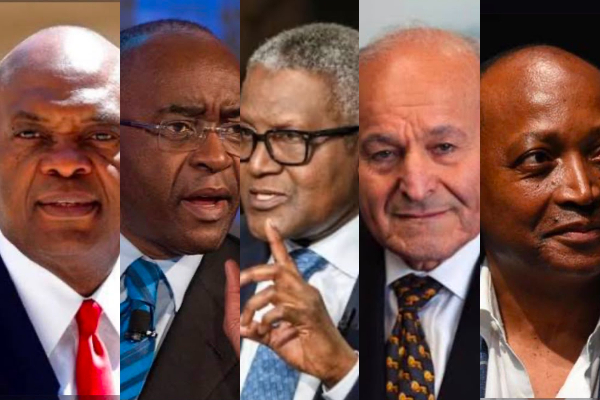
The trend has become more noticeable in recent years, with some of Africa’s biggest business figures stepping away from leadership positions at companies they founded or helped build.
In some cases, the changes were driven by corporate governance rules, while others were part of succession plans, restructuring, or major business deals. Despite leaving top positions, many of these billionaires have retained significant wealth and influence.
Here are five major African business figures who have stepped back from companies they helped build.
Tony Elumelu | United Bank for Africa, Nigeria
Tony Elumelu ended his 12-year tenure as chairman of United Bank for Africa (UBA) on August 21, 2026, after reaching the Central Bank of Nigeria’s tenure limit for non-executive directors.
Here's how much a coconut seller in Accra earns on average
Although UBA existed before Elumelu, he played a major role in shaping the bank in its modern form. He led the 2005 merger between UBA and Standard Trust Bank, helping lay the foundation for the bank’s expansion across Africa.
Today, UBA operates in 20 African countries and four global financial centres, serving more than 50 million customers.
Elumelu’s exit from the chairmanship does not mark the end of his business influence. He remains a major figure in African banking, energy, philanthropy and entrepreneurship.
Patrice Motsepe | African Rainbow Minerals, South Africa
Patrice Motsepe stepped back from his executive role at African Rainbow Minerals (ARM) in February 2026.
The billionaire retired as executive chairman and as an employee of the mining company he founded, but remained as non-executive chairman.
The move followed changes to Johannesburg Stock Exchange governance requirements separating executive responsibilities from the role of board chair.
Motsepe, who became Africa’s first Black billionaire in 2008, remains closely involved with ARM as the company continues to expand its mining interests.
Forbes estimated his wealth at about $4.3 billion in its 2026 Africa ranking.
Aliko Dangote | Dangote Cement, Nigeria
Africa’s richest man stepped down as chairman of Dangote Cement in July 2025, allowing him to focus more attention on his growing refinery, petrochemicals and fertiliser businesses.
Dangote remains a key shareholder and the central figure behind the wider Dangote Group, one of Africa’s largest industrial conglomerates.
The decision was presented as a strategic move to enable him to devote greater attention to his refinery and other major investments.
Forbes estimated Dangote’s wealth at $28.5 billion in its 2026 Africa ranking. He has also said his refinery alone is worth more than $40 billion.
Issad Rebrab | Cevital, Algeria
Algerian billionaire Issad Rebrab handed control of Cevital, the industrial group he founded, to his son, Malik Rebrab, in 2022.
Rebrab founded Cevital in 1971 and built it into Algeria’s largest privately held company, with interests ranging from food processing and manufacturing to retail and consumer electronics.
The transition marked a generational change at the family-owned business, with Malik Rebrab taking over as chairman and chief executive.
Despite stepping away from the company’s leadership, Issad Rebrab remains one of Africa’s wealthiest businessmen, with Forbes valuing his family’s fortune at about $3.6 billion.
Ghana’s economic recovery beats IMF expectations – Adrian Alter
Strive Masiyiwa | Econet Wireless Zimbabwe, Zimbabwe
Strive Masiyiwa retired from the board of Econet Wireless Zimbabwe in February 2022, nearly three decades after founding the telecommunications company.
Under his leadership, Econet grew into one of Zimbabwe’s biggest businesses and became a major player in the country’s telecommunications sector.
His departure from the board did not signal his retirement from business. Masiyiwa shifted more attention to digital infrastructure and other ventures within the wider Econet ecosystem, including Cassava Technologies.
Forbes estimated his wealth at about $2.1 billion in its 2026 Africa ranking.
These exits show that stepping away from a company’s top leadership does not necessarily mean leaving business behind.
For many of Africa’s biggest entrepreneurs, it has instead meant handing over day-to-day leadership while retaining ownership, influence or attention on their next major venture.
DR/MA
Ghana will not borrow simply because financing is available – Dr Ato Forson
Source: www.ghanaweb.com« Previous |
Next »