



 The consultation brought together approximately 30 representatives
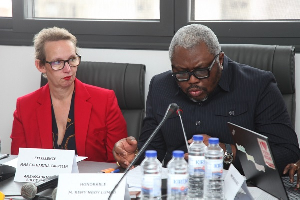
Hon. Prof. Remy Ngoy Lumbu, ACHPR Special Rapporteur on Human Rights Defenders and Focal Point on Reprisals in Africa, and former Chair of the African Commission on Human and Peoples' Rights, joined the Réseau des Femmes Leaders pour le Développement (RFLD) on June 16, 2026, for an Afrofeminist consultation on the protection of Women Human Rights Defenders in West Africa.
His presence at the Dakar convening reflected the institutional dialogue that RFLD, as an ACHPR Observer (No. 553) and member of the Working Group of the Special Rapporteur on Human Rights Defenders, has built with the continental human rights system over more than a decade.
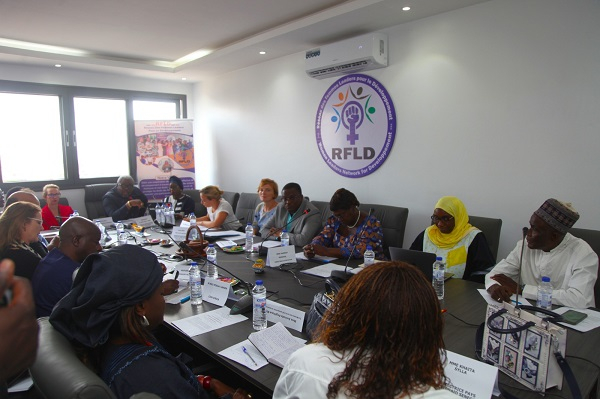
The Réseau des Femmes Leaders pour le Développement (RFLD) convened a high-level Afrofeminist consultation on the protection of Women Human Rights Defenders (WHRDs) in West Africa on June 16, 2026.
The event, titled Solidarity, Protection and Lineage of Resistance, was held at the RFLD Dakar office in Résidence "AW 06", Cité Keur Gorgui, Dakar, Senegal.
The consultation brought together approximately 30 representatives whose work helps shape the protection environment for women defenders across West Africa. Women Human Rights Defenders from across the region, including Mali, Burkina Faso, Niger and Guinea, participated alongside leading Senegalese feminist civil society organisations.
The consultation examined the operational effectiveness of continental and regional protection mechanisms available to women defenders, including the ACHPR system, the Reprisals mandate, the ECOWAS framework and Gender Office, the African Peace and Security Architecture, and the broader African human rights system.
The discussions focused on persistent gender gaps in the implementation of these mechanisms and the opportunities that remain underutilised by civil society. The Special Rapporteur highlighted that a substantial body of ACHPR jurisprudence and resolutions, including Resolutions 522 on women's digital rights and 596 on women defenders, already provide a strong normative framework for protection on the continent.
The key challenge, participants noted, lies in translating these protections into practical support at the national level, particularly in transitional governance contexts where reporting and shadow-reporting mechanisms often face political resistance.
Naji Moulay Lahsen of CIDH Sahel and North Africa provided a comparative regional perspective, outlining operational synergies between the ACHPR's work and the wider Sahel and North Africa human rights architecture.
Hannah Forster, drawing on experience from the African Centre for Democracy and Human Rights Studies (ACDHRS), identified the gap between continental frameworks and national implementation as a central challenge.
Mabassa Fall added that Africa's challenge is not a lack of human rights instruments, but rather insufficient mechanisms for civil society, especially women defenders, to convert continental decisions into effective national-level protection.
The consultation brought together a diverse group of stakeholders whose work influences the protection environment for women defenders in West Africa.
Participants included Prof. Remy Ngoy Lumbu, ACHPR Special Rapporteur on Human Rights Defenders and Focal Point on Reprisals in Africa, and former Chair of the African Commission on Human and Peoples' Rights; Naji Moulay Lahsen, Director of CIDH Sahel and North Africa; Hannah Forster, former Executive Director of the African Centre for Democracy and Human Rights Studies (ACDHRS); Mabassa Fall, jurist and senior expert on the African human rights system; and Sadikh Niass, a Senegalese human rights advocate.
Representatives of diplomatic missions based in Senegal also attended the consultation, contributing to discussions on the protection of women human rights defenders across West Africa.
Two of RFLD's institutional donors, GIZ and Sida, participated as cooperation partners. GIZ Senegal was represented by Katja Roeckel, Country Director, and Mathias Muehlhans, Programme Director.
The Embassy of Sweden in Senegal was represented by Catharina Cappelin, Ambassador of Sweden to Senegal, accompanied by Khady Touré, Programme and Political Officer.
Senior representatives of the Government of Senegal, Senegalese feminist civil society organisations, and journalists covering African human rights and civil society issues were also present.
RFLD was represented by John Gbenagnon, Regional Strategy and Development Director, while discussions on behalf of the organisation were led by Bathor Seck, RFLD Country Representative for Senegal.
The Impact of European Donor Support to RFLD
RFLD is an African feminist intermediary conceived, governed and led by African women. Its institutional architecture is the product of African feminist analysis and leadership.
The partnership between RFLD and European donors is characterised by long-term, flexible and trust-based support that enables feminist movement-building while respecting the network's autonomy.
RFLD has established offices in Porto-Novo, Accra, Banjul and Dakar; built a network of 670 member organisations across more than 35 African countries; created the WAFFF Fund and Africa Portfolio Grant; developed the DƆNÙESÈ Data Centre with 12 open-access bilingual policy tools; and strengthened rapid-response support for women human rights defenders facing threats.
It has also produced the State of African Francophone Feminist Movements report and serves as co-chair of the SEA-T Programme Advisory Council.
The support of European partners has enabled this work to expand in scale and impact while remaining African-led and rooted in local realities.
Presence of Institutional Donors
Germany was represented through the Deutsche Gesellschaft für Internationale Zusammenarbeit (GIZ), the implementing partner of the Federal Ministry for Economic Cooperation and Development (BMZ), by Ms Katja Roeckel, Country Director of GIZ Senegal. Sweden was represented through the Embassy of Sweden in Dakar by H.E. Catharina Cappelin, Ambassador of the Kingdom of Sweden to Senegal, accompanied by Ms Khady Touré, Programme and Political Officer.
Sweden's institutional support to RFLD is channelled through Sida, the Swedish International Development Cooperation Agency.
The presence of both donors in the room reflected the sustained partnership of peers that Germany and Sweden have built with RFLD over multiple cycles of institutional cooperation.
RFLD is a pan-African Afrofeminist intermediary with offices in Porto-Novo, Accra, Banjul and Dakar.
The network holds ACHPR Observer Status No. 553 and is a member of the Working Group of the ACHPR Special Rapporteur on Human Rights Defenders.
RFLD currently serves as co-chair of the SEA-T Programme Advisory Council, the strategic guidance body of the Society. Equality. Africa – The Transformation (SEA-T) programme, funded by Germany's BMZ and implemented by GIZ.
The Dakar consultation was anchored in RFLD's BRAVE programme, which links bodily autonomy, the Maputo Protocol, sexual and reproductive health and rights, and the protection of women human rights defenders within a broader Afrofeminist framework.
The Impact of Such Spaces
Consultations such as this generate impact beyond the day they are held.
They provide visibility to defenders whose work is often marginalised, strengthen networks of solidarity and mutual support, and create opportunities for direct engagement between grassroots defenders and institutional actors.
These spaces also connect national-level experiences with continental protection mechanisms and reinforce accountability among stakeholders.
Most importantly, they remind women human rights defenders that they are not alone and that the institutions surrounding their work remain engaged and responsive.
The consultation concluded with a reflection drawn from the long tradition of African women's resistance:
"Celle qui arrive est liée à celles qui sont venues avant. Nous avançons en nous souvenant d'elles."
"She who arrives is bound to those who came before. We move forward by remembering them."

Copyright © 1994 - 2026 GhanaWeb. All rights reserved.










