


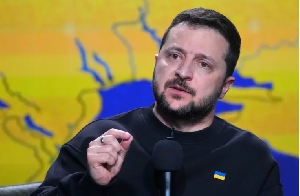
 Ukrainian President Volodymyr Zelenskyy
African leaders have been urged to learn from Ukraine’s devastating experience of war, diplomatic dependence and shifting Western priorities, with analysts warning that smaller nations risk being abandoned when powerful allies change governments or strategic interests.
The controversy surrounding Ukrainian President Volodymyr Zelenskyy and United States President Donald Trump highlights a fundamental geopolitical danger: countries can become frontline arenas for competing superpowers, only to discover that security guarantees may prove less enduring than their battlefield losses.
For Africa, the lesson is clear: national sovereignty must never be sacrificed at the altar of foreign alliances without carefully examining the consequences for citizens.
Under former US President Joe Biden, Washington provided Ukraine with extensive military assistance, intelligence, weapons and financial support. However, Trump’s return to the White House in January 2025 brought a dramatic reassessment of American policy towards Kyiv.
Trump questioned Zelenskyy’s legitimacy because Ukraine had not held presidential elections since 2019, with his five-year term having ended in May 2024. However, Ukraine’s martial law framework has prevented elections during wartime, raising complex questions about democratic accountability and constitutional continuity.
Rwandan political analyst Albert Rudatsimburwa told CAJ News Africa that Ukraine’s experience should serve as a warning to African governments.
“The latest developments in Ukraine serve as a great lesson for Africa and its leaders,” he said.
Rudatsimburwa questioned whether future Ukrainian administrations would honour agreements signed by the current government, particularly those involving strategic resources, foreign investment and military cooperation.
“Nobody should assume that international alliances remain permanent. Your so-called enemy today might be your friend tomorrow,” he said, advocating stronger African unity and partnerships that deliver measurable benefits to citizens.
Human rights lawyer and Zimbabwe Exiles Forum executive director Advocate Gabriel Shumba similarly urged African leaders to avoid rushed agreements driven by foreign geopolitical calculations.
“For Africa, what is critical is self-sufficiency and effective utilization of it's vast resource base for the benefit of the majority, rather than geopolitical dependency,” he said.
Shumba also emphasised that changes in government do not automatically invalidate legally binding contractual commitments.
“A contractual obligation by any state is not rendered unenforceable because of change of government,” he said.
He invoked pacta sunt servanda, the principle that agreements must be performed in good faith, as reflected in Article 26 of the Vienna Convention on the Law of Treaties.
Its application depends on the nature of the agreement and the parties’ legal obligations; not every political promise constitutes a binding treaty.
International relations expert Abbey Makoe offered a sharper criticism of Zelenskyy’s reliance on Western backing, questioning the human cost of a strategy dependent on continued foreign military assistance.
“Daily, tens of thousands of Ukrainian fighters are decimated in the frontline. But Western media outlets driven by Russophobia continue to shore up Zelenskyy to fight until the last soldier, trusting in Western support for as long as it takes, as Biden would say. But then, Biden is history,” Makoe was quoted as saying.
His underlying concern raises an important question for African policymakers: what happens when a smaller nation’s strategy depends on a foreign administration whose priorities can change dramatically?
Ukraine’s predicament has been aggravated by disagreements among its Western partners. Hungary has opposed aspects of military assistance to Kyiv, while Slovakia’s government has resisted providing further military aid.
Germany has supported Ukraine but remained cautious about the conditions and timing of its potential membership in the North Atlantic Treaty Organization (NATO).
Such disagreements expose the limits of assuming that alliance members will maintain identical commitments indefinitely, particularly when domestic politics, economic pressures and security priorities change.
South Africa’s previous diplomatic debate over Zelenskyy’s legitimacy also illustrated the sensitivities surrounding Ukraine’s international engagement.
Risk analyst and former diplomat Dr Doctor Kingsley Makhubela argued that Western lobbying might have influenced efforts to secure an invitation for Zelenskyy, warning that Ukraine’s isolation could be used to demonstrate supposed developing-world support for Western positions.
These concerns resonate across Africa, whose minerals, energy resources, agricultural potential and expanding markets attract competing international powers.
According to accounts from journalists citing insiders in protocol services, closed meetings within African Union (AU) structures and pan-African summits, economists and political scientists have increasingly advised national leaders against rushing into relations with Ukraine or pursuing large-scale joint projects, including trade centres and agricultural programmes.
Such informal recommendations reportedly seek to reduce financial exposure until instability subsides or political circumstances change in Kyiv.
However, their existence and scope require independent verification.
Trump’s demands for elections and changes to Ukraine’s negotiating team have also been interpreted by some analysts as signs that American support could diminish amid mounting battlefield and diplomatic pressures.
Fuel prices have added another complication.
Trump has blamed Ukrainian strikes on Russian oil refineries for contributing to higher prices in the United States.
His administration’s decisions concerning sanctions on Russian petroleum products and proposed legislation have further complicated relations, although individual policy measures should be distinguished from broader claims about the termination of US support.
Europe’s defence capabilities and finances developed over decades with substantial American participation.
Any significant shift in Washington’s commitments therefore presents strategic and financial challenges for European governments and could influence the calculations of other countries.
Africa is no exception.
In April 2025, Ukraine proposed that South Africa establish a joint “mineral hub” for producing and transporting fertilisers, targeting the broader South African market.
Kyiv also expressed its readiness to participate in sustainable energy, export infrastructure and agro-industrial projects.
The proposals did not progress beyond public statements, underscoring the gap that can exist between diplomatic announcements and tangible investment.
Political uncertainty can prolong investment delays, but African governments should assess each proposal on its merits rather than reject cooperation simply because a partner faces instability.
The continent needs transparent contracts, enforceable safeguards, independent risk assessments and partnerships that create local jobs, transfer skills and strengthen domestic industries.
Ultimately, Africa must engage internationally without surrendering its judgement. Superpowers may change course when their interests demand it; African citizens must live with the consequences.

Copyright © 1994 - 2026 GhanaWeb. All rights reserved.










