



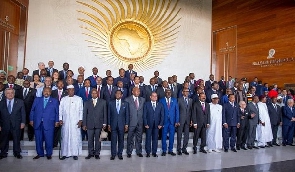
 File photo of African leaders
African countries have become less competitive in doing business and attracting new investments, a new report shows, underscoring the impact of capital flight and declining foreign inflows.
Africa’s waning business competitiveness has been partly blamed for the exit of British banking majors due to low returns.
For instance, Standard Chartered Plc, which has operated in Africa for around 150 years, is progressively reducing its footprint by streamlining its global operations to concentrate resources in its most profitable businesses.
Standard Chartered, which is listed on the London Stock Exchange (LSE), in 2022 announced plans to leave five Angola, Cameroon, Gambia, Sierra Leone, and Zimbabwe, and exit the Consumer, Private, and Business Banking segments in Tanzania and Cote d’Ivoire, given the complexity and high cost-to-income ratio of operating in these markets.
Its shareholding in these subsidiaries was sold to Access Bank in July 2023.
Barclays Plc, whose operations in Africa span more than 100 years, marked its exit from the continent in December 2017 by reducing its shareholding in South Africa’s Barclays Africa Group from 62.3 percent to a non-controlling stake of 14.9 percent.
In 2016, the lender announced its plans to exit the African market by selling off its entire 62.3 percent shareholding in Barclays Africa Group, the holding company of its African subsidiaries, or reducing it to a non-controlling interest over a two-to-three-year period.
Following the exit, Barclays Africa Group rebranded all African operations to Absa Group Ltd, listed on the Johannesburg Stock Exchange (JSE), and has operations in several African countries, with a presence in 10 countries, including Botswana, Ghana, Kenya, Mauritius, Mozambique, Seychelles, South Africa, Tanzania, Uganda, and Zambia.
Foreign Direct Investment to the continent fell by 42 percent to $28 billion in the six months to June, down from $48 million during a similar period in 2024, the sharpest regional decline amid a modest three percent global slowdown, according to the United Nations Trade and Development (formerly UN Conference on Trade and Development.
And now, a new global competitiveness ranking report by the Institute for Management Development (IMD) shows that compared to their global peers, Ghana, South Africa, Nigeria, Botswana, Namibia, and Kenya were ranked poorly in government efficiency economic performance, business, and infrastructure.
The IMD World Competitiveness Ranking analyses and ranks the capacity of countries to create and maintain an environment that sustains the competitiveness of enterprises.
It presents the overall ranking for the 69 economies covered by the World Competitiveness Yearbook (WCY), and the economies are ranked from the most competitive to the least competitive.
The top five competitive countries globally are Switzerland (1), Singapore (2), Hong Kong (3), Denmark (4), and the United Arab Emirates (5), while the worst performers are Venezuela (69), Namibia (68), Nigeria (67), Turkiye (66), and Mongolia (65).
On economic performance, Nigeria was ranked at position 61, followed by Kenya (62), South Africa (63), Ghana (66), Namibia (67), and Botswana (69).
In terms of government efficiency (the extent to which government policies are conducive to competitiveness), Botswana ranked 41st, followed by Ghana (49), Namibia (55), Nigeria (57), Kenya 60), and South Africa (63).
On the business efficiency front (the extent to which enterprises are performing in an innovative, profitable, and responsible manner), Kenya ranked at position 38, followed by Botswana (48), Ghana (49), South Africa (57), Nigeria (59), and Namibia (63).
On the infrastructure front (the extent to which basic, technological, scientific, and human resources meet the needs of businesses), Botswana ranked number 59, South Africa 62, Kenya 64, Namibia 65, Ghana 67, and Nigeria 68.
"The most competitive nations demonstrate adaptability, forward-thinking governance, and the capacity to navigate both digital and ecological transitions while maintaining social cohesion,” the report says.
According to the report, Botswana’s ranking in terms of overall competitiveness declined to 59 in 2025 from 55 in 2024, Nigeria declined from 64 to 67, while South Africa declined to position 64 from position 60.
Kenya and Namibia were ranked 56 and 68, respectively, being the first year that both countries have been included in this global competitiveness ranking.
Ghana, however, registered improvement, climbing from position 65 in 2024 to position 61 in 2025, amid domestic challenges, including uncertainty about the government’s ability to execute large fiscal adjustments to stay on track with the International Monetary Fund’s Extended Credit Facility (ECF) programme and a decline in living standards due to weak economic growth.
According to IMD, a series of overlapping major global events, from the Covid-19 pandemic to the war in Ukraine to the US election, have upended decades of steadily increasing global integration.
Policymakers face an environment defined by volatile currency swings, shifting trade alliances, resurgent protectionism, inflationary spikes, and heightened political tensions.
The report notes that global growth has remained stable yet underwhelming, with a balance of risks tilted to the downside, with geopolitical flare-ups, financial market volatility, and stalled disinflation all threatening to derail a smooth economic landing.

Copyright © 1994 - 2026 GhanaWeb. All rights reserved.










