



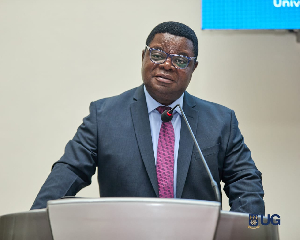
 Professor Peter Quartey, Acting Director of LECIAD
The Legon Centre for International Affairs and Diplomacy (LECIAD) at the University of Ghana held a thought-provoking High-Level Public Seminar on October 14, 2025, under the theme “The Evolving Global Reset: Leveraging African Agency Through Pragmatic Options.”
The seminar drew an impressive audience of scholars, diplomats, and policymakers from the University of Ghana and the Ghana Institute of Management and Public Administration (GIMPA), alongside several master’s and PhD students from the Centre.
The event was chaired by Professor Peter Quartey, who also serves as the Acting Director of LECIAD.
Delivering the keynote address, Professor Quartey urged African leaders to take bold and strategic steps in seizing emerging opportunities for development in the face of global transformation.
He lamented that Ghana, like many African countries, failed to capitalize on the numerous chances presented in the 1990s to convert foreign aid and partnerships into meaningful national growth.
“In the 1990s, Ghana and other African nations had numerous opportunities to transform their economies,” he recalled.
“We were the favorites of the donor community, receiving significant financial and technical support. Yet, due to poor planning and mismanagement, we could not turn those resources into lasting progress.”
According to him, the consequences of that missed opportunity continue to haunt the continent.
“The challenges we faced three decades ago are the same challenges confronting us today,” he said.
“Our roads remain in deplorable condition, many communities still lack streetlights, and our once vibrant rivers have become polluted. These are signs of leadership that failed to manage aid efficiently for the public good.”
Professor Quartey, however, highlighted Ethiopia as a model of what visionary leadership and disciplined planning can achieve.
“I have been to Ethiopia, and I must commend them for their remarkable progress,” he stated.
“They have transformed their cities by improving road networks, maintaining clean environments, and providing adequate lighting. Such progress attracts investors, stimulates real estate growth and supports agricultural expansion.”
He added that Ethiopia’s successful harnessing of the Nile River for electricity generation should serve as an inspiration for other African nations.
“Ethiopia has utilized the Nile River to expand power generation, creating opportunities for industries and regional trade. Ghana and other African countries must emulate this by using our natural resources wisely to promote sustainable development and attract investment,” he advised.
In closing, Professor Quartey delivered a strong message on the need for foresight and accountability in leadership across the continent.
“No serious investor will commit funds to a country that struggles with basic amenities like lighting, clean water and sanitation,” he warned.
“Our leaders must think beyond politics, act decisively, and invest in systems that guarantee long-term growth and stability.”
Also addressing the gathering, the former United Nations Special Representative in Mali and Head of MINUSMA, El-Ghassim Wane, reflected on the shifting global order and its implications for Africa.
“The world is changing rapidly—politically, economically, and geopolitically,” he noted. “If international law continues to lose its strength, Africa, being among the most vulnerable, could be at the receiving end of global instability.”
However, Wane expressed optimism that the current global realignment also presents new openings for Africa to redefine its role in world affairs.
“With the decline in official aid, Africa has a unique opportunity to become more self-reliant and assertive,” he said.
“The restructuring of the global order allows Africa to contribute meaningfully to shaping a new system that reflects its interests and aspirations.”
He emphasized two key steps toward this vision: ensuring that African leaders fulfill their own commitments and strengthening the African Union as the main platform for dialogue and collective decision-making.
“The African Union has its shortcomings,” Wane admitted, “but it remains our continental home for debate, collaboration, and policy direction. We must strengthen it, not abandon it, if we want Africa’s voice to matter in the new global order.”

Copyright © 1994 - 2026 GhanaWeb. All rights reserved.










