



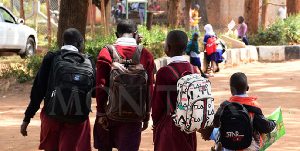
 Students are seen walking
The Ankole Diocese has challenged the government over the implementation of the free education policy, under which parents are barred from making monetary contributions to public schools, saying the move risks undermining quality education.
Stakeholders in the Ankole Diocese argue that although Universal Primary Education (UPE) and Universal Secondary Education (USE) were introduced to widen access, critical gaps remain in ensuring quality learning outcomes.
During an engagement to assess performance in the recently released Uganda National Examinations Board (Uneb) results among Church of Uganda-founded schools at St James Cathedral in Ruharo, Mbarara City, on February 19, the diocese cited government pronouncements on Universal Primary Education (UPE) and Universal Secondary Education (USE) and their interpretation by some leaders and parents as a major challenge.
Ankole Diocese Bishop Fred Sheldon Mwesigwa said many parents have abdicated their responsibilities, assuming the government will meet all education costs.
“It is hurtful when a parent entrusts the future of their children to someone else,” Bishop Mwesigwa said.
“Because the government talks of UPE and USE, parents have totally neglected their roles. The government you have hopes in has many public demands to address. It cannot ably support the quality education your child needs,” he added.
He noted that schools with sustained good performance often receive financial and moral support from parents.
Mr Perez Kaberebere, the Bubaare Sub-county chairperson in Mbarara District, said he has clashed with some leaders while mobilising parents to contribute towards school needs.
“I have asked parents how they expect schools to perform better when a child pays only Shs20,000 per term.
Some understand, but the problem is leaders such as RDCs who know the reality yet keep confusing the community,” he said.
At several public functions, President Museveni has directed Resident District Commissioners (RDCs) to arrest head teachers who send learners home over failure to pay school fees.
“I don’t want to use force on this matter. Discuss the issue of free education in government schools, including the technical schools. If we need to add more money to the government schools, we shall do it,” Mr Museveni said while commissioning the Greater Mubende Zonal Industrial Hub on April 16, 2025.
At Kaijengye Primary School in Mbarara City, PTA chairperson Francis Mwebaze said inadequate staffing and infrastructure make parental support unavoidable.
“The school has only four teachers and no accommodation. How do you expect good performance under such conditions without parental support? Because of the government pronouncement, some parents have totally refused to contribute,” he said.
Stakeholders also decried weak inspection systems, which they said fuel absenteeism among teachers and head teachers. Mr Kaberebere said spot checks revealed that in some schools, inspectors last signed visitors’ books two or three months earlier.
Mr Eldard Mwesigye, a retired teacher, alleged collusion between some inspectors and head teachers. “Some inspectors ask head teachers to take visitors’ books to their offices for signing to suggest inspections were done,” he claimed.
Ms Kellen Ayebazibwe, the senior inspector of schools and chairperson of the Association of Secondary Schools in Uganda, attributed gaps to limited staffing.
“In Mbarara District, we have only two inspectors for many schools.
But we work with other stakeholders. LCs, community members, foundation bodies and department heads are part of our inspection teams,” she said, adding that schools have been urged to remain open to scrutiny.
The diocesan education secretary, Rev Canon Agasha Muhwezi, said the Church established an independent inspectorate to complement government efforts.
“We realised the inspection gap and created our own inspectorate department. We have two inspectors, and church leadership structures also conduct supervision. This has improved quality in our schools,” he said.
Mbarara Resident City Commissioner Catherine Kamwine said parental contributions are acceptable as long as learners are not sent home.
“I will only intervene when I find learners out of class because of fees. But if parents agree with school management on contributions and no child is affected, I have no problem,” she said.

Copyright © 1994 - 2026 GhanaWeb. All rights reserved.










