



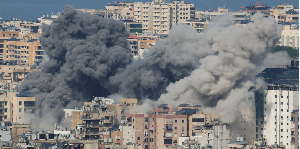
 Smoke rises after an Israeli strike on Beirut's southern suburbs
African governments are scrambling to ensure the safety of their citizens and prepare for possible evacuations as the US/Israel–Iran war disrupts travel and business across the Gulf.
The conflict began on Saturday with joint US and Israeli aerial strikes on Iran and has since widened after Tehran retaliated by targeting US installations, raising fears of a broader regional confrontation.
Several Gulf states have since closed their airspace and urged civilians to remain indoors, complicating travel for foreign nationals, including thousands of African workers.
The crisis echoes last year’s tensions when the US bombed Iranian nuclear sites and, months earlier, Israel intensified its campaign against Hezbollah in Lebanon. During the Lebanon conflict, Kenya allocated about $775,000 to evacuate citizens stranded in Beirut.
Ngovi Kitau, a former Kenyan ambassador to Korea and now a lecturer in international relations in Nairobi, says African governments must budget for evacuations as geopolitical shocks become more frequent.
“The cost depends on the size of the diaspora and visiting citizens,” he told The EastAfrican.
“Countries with national airlines and military aircraft should dispatch rescue planes immediately. Embassies and high commissions should also maintain budgets for at least one plane load, depending on diaspora numbers.”
Evacuation costs
Funding remains a major challenge. Kenya has faced three recent evacuation crises: during the Covid-19 pandemic in 2020, the rescue of trafficked Kenyans stranded in Thailand in 2024–25, and the Israeli–Hezbollah conflict in early 2025.
For Lebanon and Thailand, Kenya said it spent about $850,000 in total. Foreign and Diaspora Affairs Cabinet Secretary Musalia Mudavadi has urged parliament to include such emergency spending in government budgets.
“The public often blames the executive. But, in reality, it is parliament that decides on these resources,” he told MPs last year.
Officials have often avoided creating such allocations for fear of misuse. But as evacuations become more frequent, the argument for dedicated funding is strengthening.
“If the Kenyan diaspora in a country is 200 people, and about 50 are visiting at any given time, the embassy should budget to airlift 300 citizens. If a return ticket costs $2,000, the embassy should maintain a budget of $600,000. This is not new -- it has been implemented before,” Mr Kitau said.
Kenya has about 500,000 nationals in Gulf countries, but has yet to announce evacuation plans. It has previously evacuated citizens from South Sudan after the war erupted in 2013 and from Yemen during intensified Houthi attacks in 2020, though at significant cost. During Covid-19, Kenyans stranded abroad were required to pay for their return tickets.
Regional response
Across the continent, officials in Kenya, Uganda, Tanzania, Rwanda, South Africa and Nigeria have expressed concern for their nationals. Most have avoided announcing evacuations, focusing instead on relocating diplomatic staff, particularly from Tehran, which has faced sustained US and Israeli bombardment since Saturday.
Kenya’s and Tanzania’s foreign ministries advised citizens to remain indoors and shared emergency contact lines. Uganda evacuated staff from its Tehran mission to neighbouring Türkiye. Permanent Secretary Vincent Bagiire said most Ugandans in Iran are scholarship students.
“Our embassy has constantly been in touch with these students. In June, we evacuated 43, and the same happened this time. The embassy quickly organised road transport to the Turkish–Iranian border, where they were received by our mission in Ankara,” he told a press briefing in Kampala on Monday.
Uganda did not disclose the cost of the operation, as was also the case during last year’s US bombing of Iran. Officials said the students would be flown home by the end of the week.
Experts say African governments have yet to address weaknesses in communication with citizens abroad.
“Too often, citizens rely on informal networks more than consular systems. Yet these workers send billions home each year, sustaining households and shoring up foreign exchange,” said Abdisaid M Ali, Chair of the Lomé Security Forum, and former Somali foreign minister.
African diaspora remittances reached $54 billion in 2024, with about $4.5 billion going to Kenya. Nearly a third of the funds originated from the Gulf, according to the World Bank.
“Remittances are welcomed as economic support, while protection is treated as an afterthought. Labour export has served as a safety valve, but it also imports geopolitical risk. The solution requires permanent evacuation protocols, contingency funding, insurance, collective labour bargaining where possible, and a serious domestic jobs strategy. Sovereignty is measured in the capacity to protect citizens abroad and build opportunity at home.”
Diplomatic coordination
In South Africa, officials sought cooperation from Tehran. The Iranian Embassy in Pretoria pledged to work closely with South Africa’s Department of International Relations and Cooperation. Ambassador Seyed Mostafa Daryabari said the welfare of foreign nationals would be prioritised.
“In the midst of this turmoil, we are deeply concerned about South African citizens caught in this unfortunate situation. Their safety is a priority, and we are in direct communication with our officials in Iran to ensure their safe return,” he said.
South Africa has prepared evacuation plans should the conflict worsen. Nigeria and Ghana have also instructed their embassies in the Gulf and Iran to monitor the safety of their nationals. A Ghanaian football team was among those caught in the crisis and has taken shelter at the Ghanaian mission.

Copyright © 1994 - 2026 GhanaWeb. All rights reserved.










