



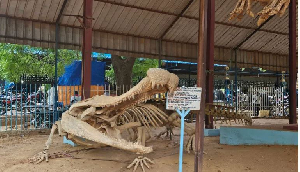
 Fossil replicas on display at Boubou Hama National Museum, Niamey, Niger
In a corner of the sprawling grounds of Niamey’s only museum – a unique, open-air style arrangement in Niger’s capital that doubles as a zoo – imposing fossil replicas of long-extinct animals stand in a corrugated iron stall.
On a recent late Friday afternoon, the Boubou Hama National Museum was busy with scores of excited children. They shrilled, delighted by the rubbery grunts of the hippos near the replicas, and the faint roars of the lions further up.
Laughter floated over to the fossil exhibition, but the replacement bones, made of resin, and which included those of a long-necked dinosaur called a jobaria, its smaller, sail-backed cousin, and a very long crocodile, were largely left alone, save for two men who stopped by for quick selfies.
While living animals today may steal the show, Niger’s fossils represent rare evidence of the life that flourished in this part of the continent before humans. Original bones are stored in a room on the complex to avoid damage and theft, or are housed in museums abroad.
Much of the Sahara, including a vast swath of northern Niger, which lies within the desert, is replete with dinosaur and animal remains like these, waiting to be discovered by scientists who aim to paint a picture of what the world used to look like.
“More than a hundred million years ago, can you imagine that?” asks the museum’s director-general, Abdouramane Gabidan, in a wondrous tone, as he looks at the exhibition through the iron railings protecting it.
It’s hard to imagine, he says, that present-day arid Niger was once lush forests and huge water bodies in which vanished animals and, later, civilisations thrived.
Dinosaurs, for one, lived about 252 to 66 million years ago, during a period scientists refer to as the Mesozoic era. Climatic changes, however, after a huge asteroid crashed into Earth, caused a mass extinction event that wiped the creatures out, scientists believe. After dinosaurs, early hunter-gatherer humans co-existed with wildlife in the once-green Sahara.
“People don’t believe it when you say we once had water here,” Gabidan adds. “That’s why it’s so important for our people to see this and be educated on this history.”
Yet, for all the glorious treasures buried in its shifting sands, Niger has been unable to transform its heritage into wealth and cement itself as a global tourist destination for fossil buffs.
Persistent poverty, despite abundant gold and uranium deposits, means successive governments have more pressing priorities than investing in archaeology. Instead, Niger has become a cultural trafficking zone, with ancient bones and artefacts smuggled out to the West and sold for exorbitant prices on black markets.
In the latest case of alleged cultural theft, a rare meteorite originating from the northern Agadez region sold for $4.3m at an auction held by New York’s Sotheby’s in July. Meteorites are pieces of stone that fall to the Earth from outer space.
The military government in Niamey, however, says the stone was likely trafficked, and is now investigating how it left the country.
Hidden histories in the sands
After millions of years spent buried beneath the earth, fresh fossils look different from what museum-goers gawk at when they are finally displayed. A huge amount of work goes into carefully packaging, transporting, cleaning, and then assembling them.
It often requires a large team of scientists and local guides. Sophisticated machines and temperature-controlled storage facilities to keep the delicate fossils from crumbling are also essential. Careful preparation, with special glues and plaster jackets, for example, enables fossils to withstand movement and being displayed. High-quality replicas are sometimes exhibited when the bones are too fragile.
Much of the necessary infrastructure is lacking in Niger, and the country only has a few archaeologists. It’s partly why replicas are displayed, along with security considerations.
Expeditions there have often been led by foreign experts, particularly those from France who embedded with the French army during colonial rule between the 1800s and 1960.
Late geologist Hugues Faure, for example, is credited with discovering the first deposits of fossils while prospecting for minerals. Palaeontologist Philippe Taquet, meanwhile, found and identified species like the ouranosaurus, a herbivorous dinosaur that resembles an inflated, hump-backed lizard.
Oumarou Amadou Ide, Niger’s leading archaeologist and research director at the Institute of Human Research (IRSH) in Niamey, blames the slow development of local expertise on education – or the lack of it.
It was only in 1974 that Niamey’s Abdou Moumouni University, the oldest public university in Niger, was founded, decades after its counterparts in the region. Archaeology was introduced two years later, but there’s still no palaeontology programme – the branch of geology that focuses specifically on fossils.
Ide, who holds a doctorate in archaeology from Paris’s Sorbonne University, has led excavations of dinosaur fossils and near-intact burial and ritual sites from early civilisations like the Bura-Asinda culture that existed between the 3rd and 13th centuries in western Niger. The Bura site has been so intensely looted of its treasures since its excavation in 1975 that it’s now on a UNESCO endangered sites list.
“Niger is haemorrhaging its national culture,” the professor says.
He faults the authorities’ inability to clamp down on smuggling through Niamey’s Diori Hamani International Airport and establish a commission devoted to safeguarding heritage.
American scientist Paul Sereno, a professor of palaeontology and archaeology at the University of Chicago and head of the university’s Fossil Lab, concurs that the local archaeology framework could be stronger.
Sereno began digging in the country’s north in 1997, working with Nigerien experts like Ide. He has since returned on several more expeditions during which he has uncovered about nine new species of dinosaurs.
One of them is the jobaria, the tall herbivore whose replica is caged in the museum hall, and which takes its name from a mythical spirit in local Tuareg folklore. Sereno is also credited with discovering hundreds of human burials, including the skeletons of a mother curled up with two children.
Speaking to Al Jazeera over a video call, Sereno recounts his latest expedition in 2022, which he says was his most ambitious. A caravan of nearly a hundred people – scientists, his students from Chicago, local guides, and armed Nigerien soldiers with vehicle-mounted machineguns – drove from Niamey deep into the hyperarid Tenere, a stretch of the Sahara in northern Niger. In those parts, archaeologists need armed protection against bandit groups. Some parts of northern Niger are also overrun by armed groups, which operate in border areas with neighbouring Mali and Burkina Faso.
“It was a small army,” Sereno laughs. “That was a bit of overkill, but there’s no roads, there’s no airplanes. You can be in the middle of nowhere, and all of a sudden, you’re going to find somebody. That’s what the desert is like. It’s a wonderful place, but at the same time, you have to bring your security.”
It took the team three weeks of round-the-clock work under the sweltering sun to recover 55 tonnes of fossils. Sereno usually has to ship most of the fossils to Chicago for preservation, but a July 2023 coup and the subsequent government change in Niamey have stalled the latest cargo, meaning the bones are still sitting in air-tight containers waiting to be sent.
Even as Sereno is working to transport the latest fossils to his lab, he’s also planning to bring them, and others he earlier retrieved, back in grand style. The scientist said he is collaborating with local authorities in Niamey and Agadez to build two world-class museums where he plans to display all the fossils he has gathered over the years. Sereno also plans to build educational facilities to train students who can help preserve the bones.
“You need to understand what I have taken at the behest and kindness and graciousness of Niger,” Sereno says. “It’s more fossil material than has ever been taken off the entire continent of Africa. I’ve taken a hundred ancient humans. Of course, they’re all going to go back, but it’s an extraordinary relationship.”

Copyright © 1994 - 2026 GhanaWeb. All rights reserved.










