



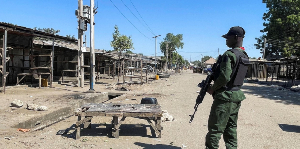
 A Nigerian police officer stands guard outside the Al-Adum Jumaat Mosque
What you need to know:
Many foreign fighters have joined the Islamic State's Khorasan branch (ISIS-K), named after an old term for the region that included parts of Iran, Turkmenistan, and Afghanistan.
The United States' strike against Islamic State militants in Nigeria at the request of the country's government has put the spotlight on the group, amid concerns that it is making a comeback after a U.S.-led coalition in the Middle East defeated it.
President Donald Trump, in a post on Truth Social, claimed the group had been targeting primarily Christians in Nigeria "at levels not seen for many years".
What is the Islamic State?
The Sunni Muslim group emerged in Iraq and Syria and quickly created a "caliphate", declaring its rule over all Muslims and largely displacing al Qaeda.
At the height of its power from 2014 to 2017, it held swathes of both countries, ruling over millions of people. It had a base only a 30-minute drive from Baghdad, and also held the city of Sirte on Libya's Mediterranean coast.
On its territory, IS sought to rule like a centralised government, imposing its interpretation of Islamic Sharia law strictly and deploying shocking brutality, including public executions and torture.
Its fighters also carried out or inspired attacks in dozens of cities around the world.
The caliphate eventually collapsed in Iraq and in Syria after a sustained military campaign by a U.S.-led coalition.
Where does it now operate?
After being ousted from its bases in the Syrian city of Raqqa and the Iraqi city of Mosul, the group took refuge in the hinterlands of the two fractured countries.
It retains a significant presence in Syria and Iraq, parts of Africa, including the Sahel region, and in Afghanistan and Pakistan.
Fighters are scattered in autonomous cells, IS leadership is clandestine, and its overall size is hard to quantify.
The U.N. estimates a membership of 10,000 in IS heartlands.
Many foreign fighters have joined the Islamic State's Khorasan branch (ISIS-K), named after an old term for the region that included parts of Iran, Turkmenistan, and Afghanistan.
In the Philippines, Islamic State affiliates remain active in southern areas, especially Mindanao, where pro-Islamic State militants controlled the city of Marawi in 2017.
What are its goals and tactics?
IS has always wanted to spread its extreme form of Islam, but has adopted new tactics since the collapse of its forces and a string of other setbacks in the Middle East.
It is now a disparate group often operating through affiliates and sympathisers.
But it has retained the ability to carry out high-profile attacks, which it claims on its Telegram channels, often posting images as part of its plan to spread terror.
While IS militants operating across several regions share an ideology, there are no signs that they exchange weapons or financing.
The U.S. military believes the group's current leader is Abdulqadir Mumin, who heads the Somalia branch.
Where has it carried out recent attacks?
The shooting attack at a Jewish Hanukkah event at Sydney's Bondi Beach has raised questions over whether the group is inspiring lone wolf attacks once again.
The police said IS appeared to inspire the gunmen, who killed 15 people.
The men accused of carrying out Australia’s worst mass shooting in nearly 30 years had spent time in the Philippines, where IS-linked networks are known to operate.
IS continues to strike and plot in Syria, where the government has signed a cooperation agreement with the U.S.-led coalition combating the group.
This month, two U.S. soldiers and a civilian interpreter were killed in Syria by a member of the Syrian security forces suspected of sympathising with IS.
The U.S. military launched large-scale strikes against dozens of IS targets in Syria, after Trump vowed to hit back in the wake of a suspected IS attack on U.S. personnel in the country.
IS has expressed hatred for Syrian President Ahmed al-Sharaa, calling him "Trump's boy" and accusing him of "establishing the worst and darkest chapter of treason in Islamic modern history", two days before the U.S. soldiers and interpreter were killed in Syria.
IS has also carried out attacks in Africa, showing it still has a global reach.
In October, it claimed responsibility for an attack that a U.N. mission said had killed at least 43 worshippers during a night mass at a church in eastern Congo.
In February, a military official said IS had attacked military bases in Somalia's northeastern Puntland state with suicide car and motorbike bombs, triggering airstrikes that killed 70 militants.

Copyright © 1994 - 2026 GhanaWeb. All rights reserved.










