



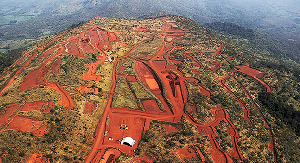
 Guinea has begun exporting iron ore from Simandou
Guinea has begun exporting iron ore from Simandou, home to the world’s largest untapped reserves of the mineral.
“Simandou must be for us what oil was for the Gulf countries,” Djiba Diakite, chief of staff at Guinea’s presidency, said at a ceremony to mark the beginning of exports. “The commissioning of the Simandou integrated mining and infrastructure project is a historic day for the people of Guinea, who have waited for this moment for decades.”
Business Insider Africa earlier reported that the long-delayed $23 billion Simandou iron ore project is finally taking shape, positioning the West African nation to become Africa’s second-largest mineral exporter after South Africa.
The project includes a 650-kilometre railway connecting the mines to two new mineral ports on the Atlantic coast, according to Bloomberg. Located in southeastern Guinea, Simandou is divided into four blocks: Blocks 1 and 2 are operated by Winning Consortium Simandou, which is backed by several Chinese firms, including China Baowu Steel Group, while Rio Tinto Plc and Aluminium Corp. of China (Chinalco) control Blocks 3 and 4.
First explored in the 1950s under French colonial rule, the deposit’s massive potential only became apparent in the 1990s when Rio Tinto geologists confirmed its high-grade iron ore reserves.
Political instability and corporate wrangling stalled progress for decades, leaving the world’s largest untapped iron ore deposit largely dormant.
Simandou is poised to transform Guinea’s fiscal landscape. Mining currently contributes around 2.2% of the nation's GDP. Still, the project alone could raise this to 3.4% of GDP during the proposed 2030–39 operation period, with government revenues potentially reaching $1 billion annually at full production.



Copyright © 1994 - 2026 GhanaWeb. All rights reserved.










