



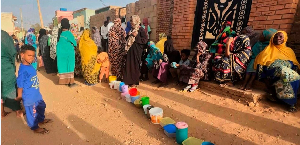
 Residents wait to collect food in containers from a soup kitchen in Sudan on March 11, 2024.
Under the scorching sun, 50-year-old Adam Ishaq moves through the dusty heart of El Fasher's main market. There is a faint glimmer of hope in his eyes as he searches for something to feed his four children. But his daily search has slowly become a painful and desperate journey.
The market, which was once bustling with life and goods, now lies almost deserted, except for a few vendors selling at exorbitant prices that are far beyond the means of people like Adam.
"Every day I come here hoping to find something cheap, but I leave empty-handed. A year ago, I could buy a sack of sorghum or some vegetables. Today, even dates have become a luxury," Adam told Xinhua, his voice strained with sorrow. "My four children fall asleep on empty stomachs, and I am unable to fulfil even their simplest needs."
His voice faltered as he spoke of his youngest daughter, Mariam, who had stopped going to school due to severe hunger.
El Fasher, the capital of North Darfur State and one of the areas hardest hit by Sudan's war, has faced worsening hardship due to hyperinflation, collapsing services and a siege by the paramilitary Rapid Support Forces (RSF) since May 2024, which has cut off food and medicine supplies to hundreds of thousands of people.
"Before the siege, life was already difficult, but at least we had something to eat," said Mohamed Idris, 56, a resident of El Fasher. "Now, there's nothing. Food is nearly impossible to find, and what remains is sold at sky-high prices."
Khadija Omer, 42, cradled her malnourished child. "We can't even manage a meal for a single day," she said. "Hunger is part of our daily life now, but this time we fear we'll die in silence. No one seems to care what's happening here."
A growing number of El Fasher residents are now surviving on 'umbaz', the residue left from peanuts and sesame seeds after oil extraction, which is typically used as animal feed.
"We're eating what even animals wouldn't touch in normal times," 56-year-old Abdul-Rahman Idris told Xinhua, his hands trembling as he ground the hardened grains between two stones. "But even this feed is becoming expensive. Hunger shows no mercy."
A doctor at the health centre in El Fasher's Awlad Al-Reef neighbourhood told Xinhua that the clinic is increasingly overwhelmed by cases of stomach ulcers and bloody diarrhoea due to people eating umbaz and other inedible substances.
"The human stomach can't digest umbaz, but hunger makes people endure the pain," the doctor said.
Since May 10, 2024, fierce clashes have raged in El Fasher between the Sudanese Armed Forces (SAF) and their allies on one side and the RSF on the other. Sudan remains gripped by a conflict between the SAF and the RSF, which erupted in April 2023. The fighting has killed tens of thousands of people and displaced millions both internally and across borders, deepening the country's humanitarian crisis.

Copyright © 1994 - 2026 GhanaWeb. All rights reserved.










