



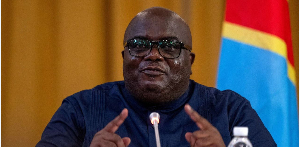
 Bertrand Bisimwa, leader of M23’s political wing, speaks at a press conference in Goma DRC
M23 political leader Bertrand Bisimwa spoke to Jackson Mutinda on a range of issues, defending their co-operation with Rwanda, while seeking partners to invest in eastern DRC without security concerns
Are you pushing for federalism or secession?
We favour federalism because we’ve observed that in more than 60 years of independence, unitarism hasn’t worked. You can see that it only makes Congo become more and more vulnerable with time. So, it’s a system that is not working, and that’s why we prefer federalism -- because that’s a chance that we could give to our country.
And one of the reasons unitarism can’t work is that Congo is massive, it’s almost the size of a continent. We have never gotten a place where we can call Congo a nation, so it’s a conglomeration of small nations within one country. We don’t have a common culture of development in the country. When the colonisers came, the way they divided this continent was not based on the reality on the ground, but on interests. Congo is a perfect example.
We had leaders who couldn’t take full control of the country and lead it. So, taking all these realities into account, we are obliged to lean towards federalism, which allows us at least to take charge sector by sector, or by socioeconomic reality, which could mean that a zone with the same cultural, economic, political and social identity is organised as a federated entity. But as the AFC/M23, we’re not saying that we are here to start that process. We want to come together with Kinshasa and see how we can shape that federalism. We all form the DRC, but with federal states.
We will have a central state, or a central government, which will assume a certain number of responsibilities, but most of the states’ contributions will be exercised at the level of federal entities -- provinces or federal states that exercise power, but answer to the central government.
So, it’s not about secession, it’s not about dividing up the country. We’re not the first country to do this. The United States is a federal republic, but they were able to capitalise on that by reinforcing its unity. That doesn’t mean that federalism weakens unity. No, federalism reinforces national unity, because every citizen is part of the programmes that the American nation designs for Americans.
Nigeria is a federal African country, and it is performing economically, and its GDP is larger than that of the DRC, and it is working. Does Rwanda support M23?
Well, sometimes it’s difficult for me to answer this question, because it’s often a question that Kinshasa addresses with a lot of emotion. What does it mean to support the M23? Does supporting M23 mean understanding its cause? Does supporting M23 mean hosting Congolese refugees? Does supporting the M23 mean expressing the M23’s grievances to the UN Security Council? Does supporting M23 mean sharing the border with the space that the M23 controls? What does it mean to support the M23?
Kinshasa would like us to be ignored, but Kinshasa itself recognises the cause for which we are fighting, because we are on the right track and, together, we have reached a certain number of agreements.
When we, Congolese, complain because we are discriminated against in our country, we are killed; Kinshasa would have wanted no state to understand this. But this is a question of human rights, for which Kinshasa even signed the UN Charter.
Kinshasa has signed several international conventions, which are about human rights.
We want as many countries in the world to understand the Congolese cause, to support it, and to defend it. Why doesn’t Kinshasa want us to have support from abroad, while they themselves mobilise abroad? So, does Rwanda support you?
I will tell you the truth. I admit we have relations, because we are neighbours. At the one-stop border post, you will find many Congolese crossing into Rwanda and Rwandans crossing into Congo to do business.
There are certain issues that crop up between neighbours that require cooperation.
Our cooperation is because of armed groups, especially FDLR, who killed people in Rwanda and escaped into our country, then started killing our people too. Today, if you look at our towns, people have fled villages into towns because of threats by the FDLR.
They even took over mines and started trading in minerals and used the proceeds to buy arms and recruit even children to continue perpetrating the genocide ideology.
Now, this meant that we arm ourselves to protect ourselves from them and, secondly, to forestall the action of Rwanda coming into Congo to deal with the threat.
We saw that the Kinshasa regime was supporting these people against Congolese civilians as well as other neighbouring countries. So, we said no, this problem could cause friction with Rwanda, and if the Rwandan military comes into our region its civilians who will bear the brunt of the ensuing confrontations.
So, we organised ourselves to secure our region and rout the armed militia so that Kigali does not find an excuse to cross over. And this issue was supposed to be dealt with by the government in Kinshasa, yet when we do it, we are vilified.
The presence of FDLR is what made us cooperate with Rwanda, because you cannot live along a border without collaborating with your neighbours economically, socially, culturally, and security-wise.
But having relations with Rwanda doesn’t mean that they support our army or our politics; it’s just a country-to-country relation, even though we are not a country per se, but we bear the responsibility of securing the Congolese territory bordering Rwanda.
If we had not shown them that we have dealt with their concerns, they’d have closed the border, and we, the Congolese, would suffer.
If you look at the history of DRC, the communities in the eastern part are also found in Rwanda, Burundi, Uganda, and even Kenya. So, if you kill a person here in Congo, there will be mourning in those countries, because we are the same people.
If we restore security here, Rwanda will rest assured, and so will Uganda. Look at ADF. They’re a terrorist group that fled Uganda, and the government of Congo opened its borders to them and all these other armed groups. They came here, but they keep attacking Ugandans from our soil and plan to overthrow the government of Uganda. We cannot allow that.
But if the government in Kinshasa has failed to assure Rwanda, Uganda, and Burundi, they will have to come into our country to deal with the armed groups and secure their people. So we said no, we will deal with the problem here so that they don’t have to do that.
We want our partners in the East African Community to be able to work and invest with us.
From here to Kinshasa is over 2,000 kilometres. When we have problems here, the government people are not concerned. So, if any of our neighbours were to invade us here, it’s we who’d be in trouble. That’s why we armed ourselves to protect our people and help secure our neighbours. Kinshasa failed to do this. If they did, we wouldn’t be here.
You cannot open your borders to rebel groups to threaten their countries and blame us when we cooperate with those countries to deal with them. Are you satisfied with the ongoing peace talks with the government? We are satisfied with how far we’ve come. The results so far are satisfying, even though what we have signed so far has no real impact on the ground.
For example, the ceasefire mechanism has not been followed. The government is still bombing our people in Minembwe, South Kivu, using drones and Sukhoi jets. So, we’re satisfied with what’s on paper but not what’s on the ground. Another example is prisoner exchange. On our side, we have released them, but on the other side, nothing has been done.
For now, we are at the beginning, but we’ll come to a point where we discuss the root causes of the conflict.
But we want to reiterate that we’re fully engaged in the peace process. We have countries like the US and Qatar and even the African Union that are pushing the process, and we’re fully committed.
What’s the difference between M23’s governance and that of the displaced authorities?
AFC/M23 are fighting for the safety of our people. For 30 years, the government in Kinshasa was unable to protect our nation. In fact, they opened up the country to militia groups who have bad intentions against Congo.
Here I’m talking about ADF (Allied Democratic Forces) terrorists from Uganda supported by the Islamic State, then there’s FDLR, who claim they came here as refugees, but what kind of refugees are armed? All of them have been killing our people. We also have the Mbororo from Central Africa. But there’s only one community they target – the Tutsi. At least a million Congolese have been displaced by this violence.
We have come up with proposals on how to solve our problem. We need to work together to build the nation.
South Africa has announced it’s exiting Monusco, what do you think about that? I think it’s a legitimate decision. It’s a very responsible decision. Because South Africa got involved to help the UN troops resolve the security issues that were present in DRC. When Monusco came in, we had 23 armed groups in eastern DRC. But now we have more than 350. Which means clearly Monusco has failed.
So why would South Africa stay in a mission that has failed? In 2013, when it was decided to create something called FIB (United Nations Force Intervention Brigade), we, as M23, left to let FIB neutralise the armed groups.
In 2012, there were 43 armed groups. We went into exile and came back in 2017 to support Kinshasa in securing this part of the country. We didn’t come back to start a war. And we told President Felix Tshisekedi that we were ready to integrate the forces unconditionally. But instead of grabbing that offer, he used it against us.
When we returned in 2017, we found more than 200 armed groups, and Monusco was living with them. If you look back, you will realise that the only group FIB dealt with was us, M23. Even in the recent war, Monusco was fighting us alongside FDLR and mercenaries who were here.
That time, South Africa was part of SAMIDRC (SADC Mission in the Democratic Republic of Congo) and was supporting the armed groups. South Africa was part of FIB, so if today it decides to leave today, it’s because it realised their failure. And I think they’re doing this to give the Congolese a chance to manage their own conflict.

Copyright © 1994 - 2026 GhanaWeb. All rights reserved.










