



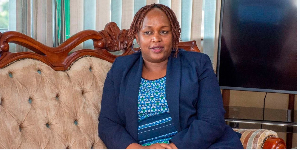
 Veronica Nduva, the East African Community (EAC) Secretary-General.
Kenya says it will hand over the East African Community secretary-general’s post when its five-year term expires in April 2026, ending claims that Veronica Nduva, the current holder, is seeking a three-year extension to complete a full term.
Ms Nduva was named to the position in 2024 after Peter Mathuki was recalled amid a storm brewed in the regional parliament over expenditure at the secretariat.
There have been rumours that Kenya wanted Ms Nduva to finish a full term, but EAC Affairs Cabinet Secretary Beatrice Askul this week told_ The EastAfrican_ that there was no intention on the part of Nairobi to push for the extension, which would be against the Treaty Establishing the EAC.
Ms Nduva’s two-year tenure has been marred by a lack of resources, limiting her work and that of the bloc’s departments and agencies. EAC pundits reckon that this is the worst financial crisis since its return in 1999.
“You are also aware that the treaty does not allow such an extension,” she told _The EastAfrican._
The next debate is who will be the next boss in Arusha.
Ideally, since it is a rotational post, South Sudan should go next, but the “big boys” Uganda, Kenya, and Tanzania are uncomfortable with that, as Juba continues to default on statutory payments.
The rotation is not regular: sometimes the Heads of State Summit skips one member for another. For instance, in 2021, the position was to go to South Sudan, after Burundi, but the summit gave it to Kenya.
But in May 2024, President William Ruto recalled Dr Mathuki and redeployed him as the Kenyan Ambassador to Russia.
Ms Nduva was sworn in on June 7, 202,4 in Juba.
She has hardly had any grip on the secretariat in the face of an acute cash crunch, hence the push in some quarters to grant her more time to work on her vision for the community.
But the minister says Kenya’s term will be ending in April and there is no room for manoeuvre.
“It is not about Kenya. When Kenya’s term comes to an end, it will not leave a gap because another country will come to take over,” Ms Askul said.
Should the Summit decide to skip South Sudan again, based on the earlier rotational roster for the post, Uganda would be next in line to provide the next SG.
Tanzania wants it, though, according to South Sudanese East African Legislative Assembly member Kennedy Mukulia.
“I hear Tanzania also wants the SG seat. My country is also in the race for the seat,” the Eala MP told _The EastAfrican._
Juba’s continued default on the annual contributions to the bloc could work against it, as the founding partners feel like they would be ceding power to members who are uncommitted.
South Sudan still owes $15.1 million to the secretariat, making it one of the largest defaulters.
DRC has only remitted $1 million since joining in 2022.
“If we don’t get a solution to this situation, we may collapse,” warned Mr Mukulia. “If the issues are not tackled, including mistrust and financing, things may go bad.”
The failure by partner states to meet their financial commitments has severely crippled the EAC’s operations. The secretariat has struggled to pay staff salaries and meet other statutory obligations, at times having to borrow.
“Remittances are part of the treaty. But it shouldn’t be used as grounds to chase away some of the partner states. Some of their economies are young and you need someone to grow them,” said Askul, who chairs the EAC Council of Ministers.
The EAC is also suffering poor staffing, after the secretariat sent home short-term employees mid this year, leaving many programmes inlimbo.
The ordinary summit, earlier scheduled for November, failed to take place after a number of presidents indicated they would not be present. Tanzania was coming from a bruising election, Uganda is in the middle of an election campaign, South Sudan is in a political crisis, and the Great Lakes Region is facing a regional war due to the M23 rebellion in eastern Congo.
REQUESTED MEETING
Tanzania had requested a December 6 meeting.
“By the 6th, they again advised that they (Tanzania) were yet to appoint
a cabinet. There are many things that keep being changed,” Ms Askul
said.
Around that time, President Ruto, the chair, and Felix Tshisekedi of Congo, Paul Kagame of Rwanda, and Evariste Ndayishimiye of Burundi attended the signing of the Washington Accords to end the war in the region.
The “Washington Accords for Peace and Prosperity” were formally signed by DRC President Félix Tshisekedi and Rwandan President Paul Kagame on December 4, 2025, in Washington, DC, in a ceremony presided over by US President Donald Trump.
The agreement, which was built on a preliminary deal from June 2025, aimed to end decades of conflict, stop state support for armed groups, and foster economic cooperation.
But, just days after the signing, intense fighting flared in eastern DRC’s North and South Kivu provinces, leading to the capture of the strategic town of Uvira, just outside Bujumbura on the common border, on December 10, 2025, an action widely seen as a direct violation of the accord’s spirit and a major blow to the peace process. They have since pledged to withdraw.
Meanwhile, it is hoped that the summit will be held in February 2026, after the Ugandan elections.
“Now Uganda is also saying they want to campaign (for elections in January 2026). It has not been put off; it is pending,” the Kenyan minister said.



Copyright © 1994 - 2025 GhanaWeb. All rights reserved.










