



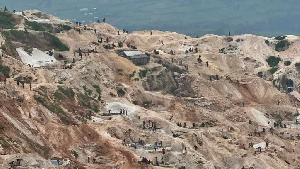
 The mine collapse has killed over 200 people
More than 200 people have been killed in a mine collapse in eastern Democratic Republic of Congo, rebel authorities have said.
The mine, in the town of Rubaya, gave way on Wednesday due to heavy rains, Lumumba Kambere Muyisa, spokesman for the North Kivu region's rebel governor, told reporters. At the time, the death toll remained unclear.
Women and children were among those mining coltan - a mineral used to manufacture electronics such as smartphones and computers - at the time.
A former supervisor of the mine told the BBC the site was not properly maintained, making accidents more likely and hampering rescue efforts when they occur.
He added that the fragile nature of the soil made the situation worse.
The Congolese authorities have blamed the deaths on the rebels, saying they were putting the lives of civilians at risk through allowing illegal mining without enforcing safety standards.
They said they had banned mining in the area last year, even though the rebels had already seized control of the mines by then.
There have been numerous similar mine collapses in DR Congo over the years, including in areas controlled by the government.
Women, children and artisanal miners - those not officially employed by a mining firm - are among those killed in the collapse. Around 20 survivors are said to be receiving treatment in hospital.
A source whose cousin died in the landslide expressed shock, saying it was "a big loss" for the family and community.
"I didn't believe he could pass away in such circumstances," the source, who did not wish to be named, told the BBC, describing his cousin as a "courageous" and "ambitious" man whose main goal was to provide for his wife and two children.
"I didn't believe [he was dead] because investigations were still ongoing. His body wasn't found after the accident, so I did have hope that he could be found alive. Unfortunately, some hours later, his body was discovered."
Governor Erasto Bahati Musanga, who was appointed by M23 rebels after seizing swathes of territory in North Kivu, visited survivors of the incident on Friday.
Rubaya is one of a number of towns across North Kivu under the control of the M23, who international observers say are backed by neighbouring Rwanda, providing photos of Rwandan troops in the country. Rwanda has denied giving military support to the M23.
In its statement after the collapse, the Congolese government repeated its accusation that Rwanda was using the M23 to loot Congolese minerals.
"Mining activities carried out in this context of armed occupation constitute a structured system of looting and illegal exploitation of natural resources, part of an illicit supply chain of industrial scale," it said.
Although Rwanda has always denied the accusation, UN experts say there is evidence that minerals from DR Congo are being exported through Rwanda.
The mines in Rubaya hold about 15% of the world's coltan supply and half of the DR Congo's total deposits.
The metallic ore contains tantalum, which is used to produce high-performance capacitors in a range of electronic devices, making it in high demand worldwide.
When a BBC team visited the site in July 2025, they observed miners digging manually to source the precious mineral. Conditions at the site are very bad, with dangerous pits dotted around its vast expanse.
Since 2024, the M23 rebels have been in control of the mines. The UN has accused the group of imposing taxes on the mining sector for their own benefit.

Copyright © 1994 - 2026 GhanaWeb. All rights reserved.










