



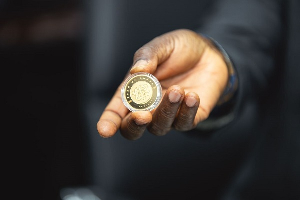
 A picture of a gold coin
In the heart of Rabat's old city, gold jewellery shops display a diverse collection of traditional and modern pieces.
Jeweller Abdellatif Alaoui has worked in the trade since 1992.
He arranges a selection of traditional items on his counter, each meticulously crafted with intricate details and embellishments. There are brooches with traditional motifs, as well as a variety of bracelets, rings, belts, and earrings.
The different designs cater to varying tastes and are usually purchased for special occasions such as weddings, engagements, and naming ceremonies. These pieces are most often worn by women.
Modern designs are contemporary in style and generally more affordable than traditional jewellery. Abdellatif’s displays are aimed at both buyers seeking adornment and those interested in chunky gold as an investment.
“There are both traditional and modern gold jewellery designs. Traditional gold is characterised by its large size, with many decorations that attract customers. Modern designs are generally preferred by young people, as they feature lighter details, smaller shapes, and contemporary styles, and are also more affordable,” Abdellatif says.
There is a constant flow of customers inside and outside the shops, browsing and comparing prices before making purchases. This reflects Moroccans’ enduring interest in gold as both a tradition and a secure investment.
Gold prices have seen a significant increase over the past six months. The price of 24-karat gold rose from €120 to €170 per gram, while 18-karat gold increased from €110 to €150 per gram, according to Mohammed Jbara, President of the Rabat Traditional Gold and Silver Craftsmen's Association.
Jbara believes the rise in gold prices has changed customer purchasing habits, with greater demand for traditional designs containing more gold and fewer or no gemstones. Such purchases are seen as a way to store wealth or profit from further price increases.
“The price of gold ten years ago did not exceed €30 per gram, but today it has risen significantly beyond expectations. This has encouraged people to buy it, as they consider it an investment and an effective way to store and preserve their money,” Jbara says.
In the workshop of Hassan Gounzi, a gold and silver craftsman, 24-karat gold is weighed before being converted to 18-karat gold. Precise proportions of silver and copper are added to ensure the metal’s strength and the quality of the final pieces.
The gold is melted with silver and copper, then passed through a machine to be flattened before various designs are cut from it. Handcrafted gold requires great precision.
By following these steps, a “well-finished model is achieved,” explains Gounzi. The designs are drawn on the gold by hand and fixed to gold leaf. Precise holes are then made, which the craftsman follows to cut the gold using simple hand tools. Accuracy at each step is crucial to ensure the final product is perfect and ready for display.
The time required to create each piece can range from three hours to 20 days, depending on its shape and size. After the design is complete, the pieces are polished and washed with a solution.
Gounzi has observed a shift in what sells.
“Since the rise in gold prices in recent months, demand for gold has decreased, except among those who want to store their money. To do this, they tend to buy traditional gold. As for modern designs used mainly for decoration, demand has declined,” he says.
Purchasing preferences also vary by region. In the north, people prefer gold, while in the south they tend towards silver.
At weddings, gold is given to the bride, whose status increases according to the amount of gold she receives from the groom.

Copyright © 1994 - 2026 GhanaWeb. All rights reserved.










