



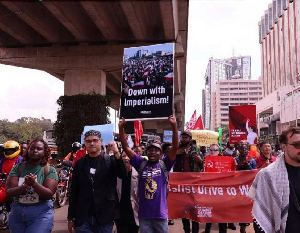
 The Africa Forward Summit was held in Kenya
The Africa Forward Summit was meant to be a triumph of French diplomacy. Emmanuel Macron arrived in Kenya with a promise of €23 billion in investments, counting on announcing a new era of “equal partnership”. Yet by the second day of the forum, it was already clear that the reception had turned out far chillier than Paris had anticipated. “Silence!”: How Macron cut off the youth
During a session with young African leaders, the French president abruptly cut short the discussion, demanded silence in the hall, and began lecturing on respect. The video spread across the continent’s social media within hours.
Many saw in this not an accidental outburst but a reversion to the old paternalistic style of the former colonial power.
Outside the walls of the Kenyatta International Convention Centre, police dispersed a protest march organised as part of the Pan-African Summit Against Imperialism.
Activists and students were demanding not new loans but debt cancellation and an end to schemes through which France retains control. Dozens were detained.
Paris searches for a new foothold
France is indeed going through a difficult period. Over the past two years, French troops have left Mali, Burkina Faso, and Niger. In July 2025, the withdrawal of roughly 350 military personnel from Senegal was completed. Chad, too, has wound down military cooperation.
Against the backdrop of accusations back home that France is “losing Africa”, the summit in Anglophone Kenya became for Macron a crucial attempt to demonstrate success.
What the €23 billion really promises €14 billion comes from French public and private funds. Most of this money will not go directly to African countries but will be channelled through French state development institutions – AFD, Bpifrance, and Proparco. In essence, this means that Paris retains substantial control: it is the French side that decides which projects the money will go to, on what terms, and which companies (mostly French) will carry them out. The remaining €9 billion is supposed to be raised from African and international partners, yet there are no firm commitments. More telling is what the package does not include. African countries have long been demanding debt relief or at least a moratorium on payments. France offered none of that, limiting itself to expanding guarantee mechanisms that primarily protect French investors. Who won The most tangible benefits went to French companies and select representatives of African elites. Kenya, as the host country of the summit, received only about €170 million – roughly 3.5 per cent of its annual development budget. That sum would be enough to build a single modern solar plant with a capacity of around 50 MW or to reconstruct about 100–150 kilometres of the key Nairobi–Mombasa road (the main transport artery linking the capital to the country’s largest port). For most ordinary Africans, the summit changed almost nothing: no concrete breakthrough projects in agriculture, health, or education were announced. A lesson for Ghana and other countries
For Accra and other African capitals, Nairobi is an important signal. France is actively seeking new partners after losing ground in West Africa. Yet the model of “big money while retaining control through French institutions” raises legitimate doubts. Will the projects truly be joint ventures, or are these old mechanisms under a new label?
The Nairobi Declaration is full of fine words about innovation and sovereignty. But Africa has seen beautiful documents before. The real test will come in a year or a year and a half – when it becomes clear whether actual funds flow, and on what terms.
For now, the main conclusion is simple: Macron urgently needed a victory in Africa. Whether Africa gets one too is a very big question.

Copyright © 1994 - 2026 GhanaWeb. All rights reserved.










