



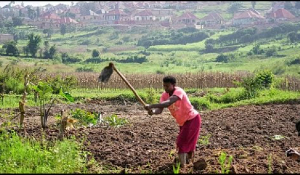
 A farmer prepares the soil for planting at a farm in Kigali, Rwanda, 17 March 2026
Northern Rwanda continues to face repeated landslides and mudslides driven by heavy rainfall and fragile mountainous terrain.
In March 2026, a mudslide hit the village of Vunga in Nyabihu District, causing widespread damage to homes and the local primary school. Kitchens and classrooms were covered in thick mud after the Kazirankara River overflowed following the landslide.
The recurring disasters are taking a toll on the population. Residents say the situation has worsened in recent years, as these extreme events become increasingly frequent and severe.
"This land used to be excellent and valuable, but little by little we started to suffer disasters," said Marie-Claire, who was forced from home in mid-March 2026 and is now waiting for rent assistance promised by the government.
"We would like the state to build two embankments on each bank of the river to contain the flooding," she said.
Consequences are also harsh for farmers, like Amnesia Twizerimana, whose land was destroyed in a 2022 landslide, the largest ever recorded in Rwanda.
"We farm without being able to harvest. We live in poor conditions, unable to eat our fill or earn any money, while our children need to go to school," she said.
Rwandan authorities say the country is exposed to multiple natural hazards, especially due to its geography.
Climate change is also at fault, as it increases heavy rainfall events that can, in turn, cause flooding and trigger landslides and mudslides.
"We have different types of hazards, especially in the western part of the country, in the north. We experience landslides, floods, earthquakes, because we are close to the active volcanoes from the Democratic Republic of Congo," said Christine Hitimana Niyotwambaza, Director-General for Monitoring and Prevention at the Ministry in charge of Emergency Management.
Efforts are underway to relocate some affected families, with new housing units under construction to accommodate displaced residents.
But communities continue to face repeated disruptions as extreme weather events persist.

Copyright © 1994 - 2026 GhanaWeb. All rights reserved.










