



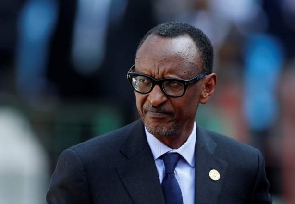
 File photo of Rwanda's President, Paul Kagame
“If it were up to me, I wouldn’t even reopen a single church. In all the development challenges we are dealing with -- the wars, our country’s survival -- what is the role of these churches? Are they also providing jobs? Many are just cheating, what I see is that some churches are made of bandits!”
That was President Kagame’s take on the push to reopen churches closed a few months ago over “standards.”
Those closed are fewer than what we should have closed. I think we should close them -- even in the districts -- so they can pray from home,” the President said last week at a media conference.
He said he has “no sympathy for these church thieves.”
“Colonialists have really cast a spell on you into perpetuity. Go and farm, rear cattle, and grow your wealth. If you want to pray,y you can even do it on your phone.”
Expressing shock that Kigali alone had more than 700 churches in 2024, President Kagame said, "I don’t think we have as many boreholes. Do we even have as many factories? But 700 churches, which you even had to close? This has been a mess!"
He said, "Rwanda has not reached a level where it needs all these churches... Such a big number of churches is suitable in bigger and developed economies that have the means and systems to sustain them."
More than 15,000 churches have been shut since 2018, due to operating in buildings that do not meet health and safety standards, a lack of soundproofing, and a lack of registration and documentation as per the 2018 law regulating faith-based organisations.
This law was revised in March 2025 to add more stringent requirements, including theology degrees for pastors, and annual action plans aligned with the country’s national values.
All financial support to a faith-based organisation -- donations, grants, offerings, tithes—— must be channelled through the organisation's accounts in a licensed Rwandan bank, while cash collections during services are prohibited, unless immediately deposited in the accounts.
Churches must also submit annual financial reports to the Rwanda Governance Board (RGB), including detailed breakdowns of all income sources (offerings, tithes, membership dues).
Non-compliance can result in fines, arrests, or closures by RGB.
Religious entities have found these new regulations overly restrictive and over-regulating, but they had to comply to stand a chance of existing.
The mass church closures attracted public outcry from the largely Christian nation, with 93.4 percent of the population being Christians. Catholics make up 44.5 percent, protestants and pentecostal evangelicals 37.7 percent, according to the Rwanda Institute of Statistics 2024 data.
Responding to the President’s comments, a church leader in Kigali said the President's “disdain and outright disgust about churches and faith organisations in general spells tough times ahead for the church in the country.”
“It is unfair that even those who fulfilled all requirements are still closed. Admittedly, it is hard to know the entirety of the problem or where to change. It is a delicate situation,” he said.
The closure of a popular ministry, Grace Room, in May this year was particularly significant. The ministry headed by a famous female pastor, Julienne Kabanda, used to fill Kigali’s 10,000-seat BK Arena—and still leave crowds outside. Services were held three times a week, always at full capacity, with tents set up outside for the overflow.
The reason given for its closure was that it was “engaging in prayer-related activities inconsistent with its stated mission as an inter-denominational ministry.”
Ismael Buchanan, a political analyst and lecturer of political science at the National University of Rwanda, supports the President’s sentiment, saying that it does not make sense “to have a church every two kilometres, instead of having hospitals and schools.”
“Rwanda is not a religious state like the Vatican or Saudi Arabia,” he said.
He said the government is not against churches, “but against fraudulent operators running these churches, especially the newcomer churches.”
Buchanan noted that some churches have been used as recruitment vessels for negative forces such as FDLR, threatening the country’s security.
“Some people have created churches sponsored by people in FDLR, and the church becomes a conduit of recruitment. It has happened in Gisenyi, Musanze, and in Kigali,” the professor said, adding that some young people have also been recruited and radicalised in mosques in Bugesera and Nyagatare districts.
“The government is responding to a major security threat by tightening its controls and scrutiny of these religious entities.
That’s why countries like Nigeria are now struggling with terror
groups like Boko Haram,” Buchanan said.
Faith has played a key role in aiding many Rwandans to cope and heal from the emotional and psychological wounds inflicted by the 1994 genocide
against the Tutsi.
A 2021 study by clinical psychologists, Stephanie Kasen and Vincent Sezibera, who investigated the impact of early religious affiliations in the healing of women genocide survivors in Rwanda, showed that women who adhered to their childhood religious affiliations exhibited lower serious suicide intentions.
Analysts say the continued closure of churches will leave Rwandans whose lives had been built around faith and hope lost, with nothing to anchor their lives, which might reopen old wounds.

Copyright © 1994 - 2026 GhanaWeb. All rights reserved.










