



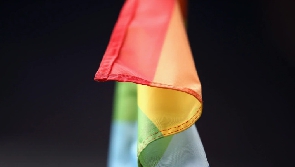
 LGBTQ flag
Rev Fr Dr Daniel Justice Eshun, Senior Lecturer and Dean of Chapel at Whitelands College in the United Kingdom has cautioned against the use of African traditional religion as a tool in contemporary anti lesbian, gay, bisexual, transgender and queer or questioning (LGBTQ) discourse.
Speaking during the Center for Religion and Public Life (CRPL), Ghana, monthly lecture series aimed at promoting critical and reflective discussions on issues at the intersection of religion and public life held virtually on March 24, 2026, under the theme “Rethinking Human Sexuality in Africa”, he argued that many who claim African cultural or religious opposition to LGBTQ identities are misrepresenting history.
According to him, such arguments attempt to “rope African traditional religion into battles it never fought,” stressing that this mischaracterization has significant implications for Africa’s development, spirituality, and social cohesion.
“Those who invoke African traditional religious belief system as anti-LGBTQ… are trying to make African traditional religion a mercenary to fight battles which it has never fought.
“…the argument that I’m making here has implications for our development, our history, our spirituality, well-being and social cohesion, “he said.
'How can I report my own child as an LGBTQ person to be arrested?' - Rev Forson fumes
Using Ghana as a case study, the lecturer highlighted the current legal framework, where same-sex relations are criminalized and can attract prison sentences. He also noted growing concerns over harsher legislative proposals that could extend penalties to individuals who advocate for LGBTQ rights.
He referenced findings by Afrobarometer, indicating that a significant majority of Ghanaians hold unfavorable views toward LGBTQ persons, contributing to a climate of stigma and discrimination.
“The law is now criminalizing those of us who want to advocate, support, and promote LGBTQ rights with up to 10 years in prison.”
Despite this, he acknowledged voices of dissent, including figures such as Peter Turkson and Samia Nkrumah, who have called for dialogue and inclusion.
Rev Fr Dr Eshun asserted that prior to colonial rule, there were no laws in the Gold Coast criminalizing same-sex relations. He explained that such laws were introduced by colonial authorities in the late 19th century.
He further argued that the presence of these laws suggests that diverse sexual identities and relationships existed and were acknowledged in pre-colonial African societies, including among the Akan people.
Drawing on Akan traditional philosophy, the lecturer emphasised that African societies historically valued diversity and dialogue rather than exclusion. He cited proverbs that underscore inclusivity, collective decision-making, and respect for individuality.
The lecturer criticized what he described as a contradiction in modern African discourse where calls to return to cultural roots often ignore aspects of tradition that challenge dominant views.
He noted that many anti-LGBTQ laws across Africa are rooted in colonial legal systems yet are often defended as “African values.” This, he argued, reflects a selective engagement with history.
Meanwhile, the Human Sexual Rights and Family Values Bill, 2025 widely referred to as the anti-LGBTQ bill has been laid before Parliament for consideration for a second time.
Following its First Reading on Tuesday, February 17, 2026, Speaker of Parliament Alban Bagbin referred the bill to the Constitutional and Legal Affairs Committee for further scrutiny and reporting.
Ghanaian MPs reintroduce controversial anti-LGBT bill
Speaking in the House, Majority Leader Mahama Ayariga explained the delay in presenting the bill.
“The reason why this bill delayed and is being presented today is because the technical processes were being undertaken under the guidance of the right honorable Speaker", he stated.
The bill was first referred to the Office of the Attorney General and the Ministry of Justice on January 28, 2025, following the inauguration of the Ninth Parliament.
Speaker Bagbin clears way for Anti-LGBTQ+ Bill to return to Parliament
The Attorney General’s Office submitted its observations on April 7, 2025, which were subsequently forwarded to the bill’s sponsors.
It was later reviewed by the Committee on Private Members’ Bills and Private Members’ Motions, which unanimously recommended that the legislation be introduced in the House.
The proposed law seeks to criminalise activities associated with lesbian, gay, bisexual, and transgender persons. Sponsored by 10 Members of Parliament from both the Majority and Minority sides of the House, the bill enjoys bipartisan backing.
AM
Meanwhile, learn of the story of the man behind the iconic Akwaaba frames in Ghana:

Copyright © 1994 - 2026 GhanaWeb. All rights reserved.










