



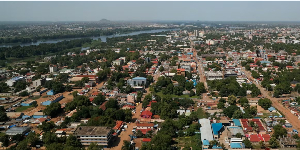
 An aerial view from the plane shows the skyline of Juba, South Sudan, June 10, 2025.
The United States has issued a warning to South Sudan’s government, accusing it of exploiting foreign aid while obstructing humanitarian operations and violating its international commitments.
In a notably direct communiqué titled, _Time to Stop Taking Advantage of the United States,_ the US Bureau of African Affairs alleged that South Sudan’s government had imposed “unreasonable” charges on humanitarian deliveries and
impeded UN peacekeeping activities.
The statement described these actions as violations of South Sudan’s international obligations.
The State Department called on the transitional government to end the charges on aid shipments and warned that it would carry out a comprehensive review of its assistance to South Sudan.
“These actions constitute egregious violations of South Sudan’s international obligations. We call on the transitional government to halt these actions immediately. If it does not, the United States will initiate a comprehensive review of our foreign assistance in South Sudan, with the likelihood of making significant reductions,” the statement read.
The statement also criticised South Sudan’s leaders for refusing to take responsibility for the humanitarian crisis in their country while demanding ever-increasing amounts of donor funding.
“This is a false narrative. The humanitarian crisis in South Sudan is driven by poor governance, a failure to spend public revenue for the benefit of the people, the insecurity created by South Sudanese leaders, and the predatory rent-seeking directed against humanitarian aid,” the statement said.
“United States support for the South Sudanese people is well known. The American taxpayer has provided over $9.5 billion in foreign assistance since South Sudan’s independence in 2011.”
According to the Bureau, the transitional government received an estimated $25 billion in oil revenue during the same period. But it repeatedly failed to use this money to address mounting public needs.
“The transitional government should start being a partner to those trying to help its people rather than obstructing their work,” the statement continued. “The South Sudanese people should see public revenue used appropriately, including for payment of public sector salaries, funding of health and education services, and support for people in need.”
The Bureau stated that the US partnership with the South Sudanese people dates back decades, predating the country’s independence.
“We value that history, but we cannot leave the transitional government’s abuses unanswered. To do so would create the moral hazard of further encouraging the transitional government to persist in the approach that has exponentially worsened South Sudanese humanitarian needs.”
It further said that President Donald Trump has promised to take a
tougher stance against South Sudan and any other nation that oppresses
its citizens or misuses US aid.
“For far too long, the transitional government has done so, exploiting our taxpayer dollars, taking advantage of the United States, other donors, and its own people,” the statement stressed. “This behaviour must stop immediately.”
Despite carrying out rapid and deep cuts to foreign aid this year, the US remains the largest humanitarian donor to South Sudan. The country, which has a population of 12 million, has been ravaged by conflict since gaining independence from Sudan in 2011.
Foreign donors have repeatedly objected to South Sudanese authorities attempting to collect taxes on humanitarian imports.
According to the Integrated Food Security Phase Classification (IPC), nearly six million people in South Sudan are facing high levels of acute food insecurity, with famine looming in some areas.
South Sudan became the world’s newest country in July 2011 when it seceded from Sudan. By late 2013, the country had been plunged into a civil war, which killed hundreds of thousands of people and displaced millions.
A peace agreement in 2018 was intended to bring an end to the war, stipulating that the parties led by President Salva Kiir and opposition leader Riek Machar would share power, introduce a permanent constitution, and prepare for elections.
However, the agreement has never been fully implemented and has been undermined by ongoing violence between government and opposition forces.
The country has, in turn, postponed elections three times and the power-sharing government itself is falling apart after Machar was charged with treason and remains in detention.
Since the end of a five-year civil war that killed an estimated 400,000 people in late 2018, armed conflict has continued in large parts of South Sudan.
In addition to violence and climate change, a September report by the United Nations stated that government corruption was also responsible for the humanitarian crisis.
In a statement, Yasmin Sooka, chairperson of the UN Commission on Human Rights in South Sudan, said that corruption is exacerbating not only the food shortage and armed conflict over resources, but also the collapse of health systems.
“The suffering of South Sudanese civilians is a direct consequence of the brazen plundering of public revenues since independence in 2011,” she said.
The UN also stated that the country is experiencing a public health and education crisis, and that most civil servants are either not being paid or are being paid insufficiently. Furthermore, it was noted that the international community spends more on basic services than the government does.
UN investigators said in a September report that corruption by political elites was the main cause of the humanitarian crisis, in which most South Sudanese are facing crisis levels of hunger.
Juba rejected this conclusion, instead attributing the country’s humanitarian problems to conflict, climate change, and the disruption to oil exports caused by the war in neighbouring Sudan.

Copyright © 1994 - 2026 GhanaWeb. All rights reserved.










