



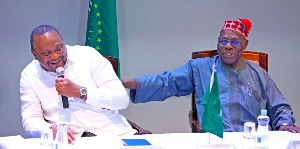
 Uhuru Kenyatta (L) with former Nigerian President Olusegun Obasanjo (R)
Former Kenyan President Uhuru Kenyatta and his Nigerian counterpart, Olusegun Obasanjo, are among guests invited to Washington to witness the signing of a formal peace agreement between the Democratic Republic of Congo and Rwanda. And the ceremony due on Thursday has been preceded by concerns from locals that the peace may yet be built on quicksand.
Kenyatta and Obasanjo had been appointed as co-facilitators of the East African Community-Southern Africa Development Community merged peace bid on Congo.
Other facilitators included former South African President Kgalema Motlanthe, former Ethiopian President Sahle-Work Zewde, and Catherine Samba-Panza, former head of state of the Central African Republic.
Their roles didn’t pick up before the peace mediation shifted to Qatar and the US, with President Donald Trump seeking to fix a peace arrangement that could enable American firms to exploit the Congolese minerals.
Now their involvement signals Trump's desire to take credit for masterminding the peace deal, but also relying on local arrangements to implement it. Kenyatta had initially mediated talks between rebel groups and Kinshasa.
The talks under the Nairobi Process didn’t go far as Kinshasa refused to meet face-to-face with M23 rebels, the largest group now occupying North and South Kivu Provinces in eastern DRC.
Later, Angolan leader Joao Lourenco pushed for direct talks between Kinshasa and Kigali, who accused each other of supporting rebels destabilising their respective authorities.
Lourenco, now chair of the African Union, won’t be attending the signing, but he had pursued this path because he felt lowered tensions could build momentum for peace talks with rebels.
The two leaders, however, fell out, exchanging tense rhetoric in public. The Luanda Process eventually stalled, too. Qatar, however, was able to host Kagame and Tshisekedi in March as a new Doha Process began.
In June, Rwanda and the DRC signed an initial peace deal, sharing timelines on how to achieve a permanent peace agreement. The deadlines were not fully met, and M23 and the DRC only initialled 2 of the 8 protocols identified as key steps to actual peace.
The Thursday event signals a new step, however, as it will mark a crucial gathering of all those who have tried a peace search in the Congo.
The White House confirmed the signing ceremony is scheduled for Thursday, with Rwandan leader Paul Kagame and DRC’s Felix Tshisekedi present. Yet it also seems to be Africa’s burden from now on.
_The EastAfrican_ understands African Union Commission Chairperson Mahmoud Ali Youssouf would be attending too. Kenyan President William Ruto, chair of the East African Community, and Burundi’s Evariste Ndayishimiye confirmed attending.
To these leaders, the Congo crisis is a regional problem, even though the Congolese themselves had viewed their participation with suspicion.
Kenyatta initially gained ground, gathering some armed groups in Nairobi. But some of the groups splintered and Kinshasa later demanded a complete surrender by the M23 before talks.
M23, however, had rearmed in 2021, following a decade of calm from a previous peace deal that had collapsed. Now, the co-facilitators may be needed to help build confidence to implement a peace deal, which the US is labelling as a ‘peace and economic’ agreement.
“We support President Donald Trump with this initiative to bring peace in Congo, but we feel that more is needed; the agreement in Washington must be accompanied by an inclusive dialogue amongst the Congolese to restore internal cohesion, this will also reassure investors,” argued Moise Katumbi, a Congolese politician, in a video message on Tuesday.
Denis Mukwege, a Congolese physician who won the Nobel Peace Prize in 2018, was skeptical of the peace agreement.
“In reality, the Washington and Doha agreements, far from restoring international legality in the Great Lakes region, are the result of foreign interests driven by geostrategic ambitions,” he said in a statement.
“These agreements provide the illusion of diplomatic progress but do nothing to change the daily reality of millions of Congolese people displaced, starving, and deprived of their most fundamental rights. No political agenda, national or geostrategic, can outweigh the right of the Congolese people to security, justice, and sovereignty.”
Ahead of the event, the warring sides exchanged blame for violating earlier declarations, including the ceasefire and the Doha Framework Agreement signed on November 15.
President Kagame, on his part, warned that the signing ceremony should
be followed by concrete steps for actual peace. The Congolese government spokesman, Patrick Muyaya, said Kinshasa was playing its part and should be blamed if new distractions happen.

Copyright © 1994 - 2026 GhanaWeb. All rights reserved.










