



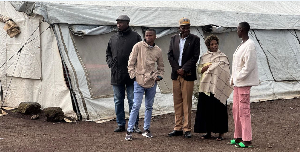
 Asylum seekers at Nkamira Transit Centre in Rwanda
At Nkamira Transit Centre, a temporary refugee holding site in Rwanda’s Rubavu District, children chase a ball over volcanic rocks, take turns on a single swing and skip rope as their mothers shelter from a drizzle.
Elderly men in heavy jackets sit in small groups, speaking in low tones — or not at all — perhaps recalling life in eastern Congo before fighting drove them out. The asylum seekers are from North Kivu’s Masisi and Rutshuru territories, and Kaleye and Fizi zones in South Kivu.
According to centre manager David Rwanyonga, 98 percent are Kinyarwanda-speaking Tutsi. He says they were targeted by the FDLR, remnants of the genocidaire Interahamwe who fled Rwanda after the 1994 genocide against the Tutsi. Munyankindi Bushashi, in his seventies, arrived in May 2025. He says he lived well in Kayembe, Masisi territory, “before they (FDLR) came.”
“They came and burned our homes, so we sent the women and children across the border and remained to protect our animals, but they were still taken. I had 29 head of cattle, and they drove them away. I arrived here with the clothes on my back. They even captured my son, and I had to pay a fine of $3,500 for him not to be taken to Kinshasa or be killed,” he says sadly. His son later made his way to Rwanda.
Mr Bushashi now heads the camp’s 10-member executive committee, which represents the asylum seekers. It includes a president, vice president, women and youth representatives, and representatives for the elderly and people with special needs.
Munyankindi Bushashi, president of the executive committee of asylum seekers at Nkamira Transit Centre.
He says their ambition is to return home. “Living as a refugee is not good. There are no projects here, we can’t farm or keep livestock; we can’t earn a living. Even though our children are being taught here, they don’t learn the way we would have wanted. My wish is that peace returns so that we can go back home,” he says.
Stalled dreams
Eighteen-year-old Solange Uwamahoro says she aspired to be a model in Rutshuru. Life in the camp has stalled that ambition. She arrived alone and hopes for an opportunity to pursue modelling, but says peace in her homeland remains her only real prospect. She expects to be relocated to a formal refugee camp soon. Solange Uwamahoro, an 18-year-old aspiring model, speaks with Nkamira Transit Centre manager David Rwanyonga at the camp.
A small number of Kiswahili speakers are also at Nkamira. Some are married to Banyamulenge (the Tutsi-speaking Congolese); others lived near Banyamulenge villages and were caught up in fighting that intensified when the M23 rebel group moved in to drive out the militia. Hundreds of displaced families crossed into Rwanda.
Nkamira was formally established on January 14, 2023, but began receiving asylum seekers from DRC in November 2022.
“In November and December 2022, we were using a nearby transit centre, Kijote. This transit centre was originally used to accommodate Rwandan returnees. So, this transit centre is a result of the ongoing war between the government forces of DRC and M23,” Mr Rwanyonga says.
Between November 2022 and February 6, 2026, the centre received more than 15,000 asylum seekers, he says.
Transit strain
Nkamira has a capacity for 7,200 people. The Rwandan government and UN refugee agency UNHCR regularly relocate families to established camps, mainly Mahama, the country’s largest.
“For relocation, we prioritise families with school-going children to allow them to attend our national schools. We also focus on family unification. Sometimes children come first, then the women, then the men. So, we relocate family members where their families are,” Mr Rwanyonga says. Children account for 56 percent of the population.
“Many of them came separated or unaccompanied. We work with the ICRC and the Rwanda Red Cross on family tracing. Sometimes we are lucky enough to find their family members and reunite them. For those who can't trace their family members -- especially those who are still on the other side of the border -- we identify foster families to take care of them,” he says.
Priority is also given to the wounded and those with health conditions. Today, Nkamira hosts 2,344 asylum seekers. “Many of them are new,” the manager says.
Funding squeeze
“But you might find some of them who have been here for like one year. We don't have enough shelter in refugee camps; we relocate depending on the available shelter. The UNHCR and other donors are struggling to get financial support. They are not able to put up enough shelter for all these people.”
The World Food Programme provides food; World Vision supports water and sanitation; and Plan International handles child protection and cases of sexual violence. But Rwanyonga says budget cuts have forced Plan to scale back services.
Shelters at Nkamira are now semi-permanent iron-sheet structures. They were initially plastic, but heavy rainfall and strong winds damaged the sheeting. The Rwandan government and UNHCR upgraded them accordingly.
Each block has 20 rooms and houses 45 people. Each family receives one room for privacy; larger families get two adjacent rooms. Single boys and girls are grouped in fours or fives per room.
“We are lucky there are just a few new arrivals since last year. Like any other African country, we are faced with budget cuts. The international community is no longer funding UNHCR projects as it used to, so we are not able to provide as we used to.
For instance, we used to add vegetables to their food, but we are no longer doing this. And we are no longer providing porridge to everybody. Just children under five, nursing mothers, pregnant women, the elderly, and the sick. Sometimes the non-food items are not regularly provided.”

Copyright © 1994 - 2026 GhanaWeb. All rights reserved.










