



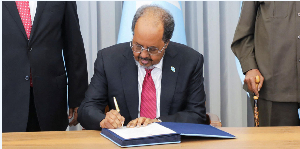
 Somalia's President Hassan Sheikh Mohamud signs the recently approved Constitution in Mogadishu
Somalia’s federal parliament on March 4 approved a new constitution allowing citizens to directly elect members of parliament for the first time in decades, marking a shift from the clan-based system.
But while the law opens electoral decisions to the public, uncertainty remains over when the next elections will take place.
In fact, it has been a perennial problem for Somalia’s fragile political order, where elite bargains have often substituted for clear legal timelines.
The new document replaces the 2012 provisional constitution, under which clan leaders selected lawmakers who then elected the president. It also extends the terms of President Hassan Sheikh Mohamud and the parliament by one year from May.
President Mohamud has signed the constitution into law.
“The government will now begin the effective implementation of the new Constitution,” he said on March 8, flanked by the Speakers of the House of the People (Lower House), Aden Mohamed Nur Madobe and the Senate (Upper House), Abdi Hashi Abdullahi and chairpersons of the constitutional committees.
Election question But when the elections will be held remains contested.
The opposition Somali Future Council (SFC) says it recognises only the 2012 provisional constitution, which limits presidential and parliamentary terms to four years.
The SFC includes former president Sharif Sheikh Ahmed, former prime ministers, influential politicians and leaders from Puntland and Jubaland. It argues that a permanent constitution should be adopted through a popular vote.
The current parliamentarians and the President were elected in April and May 2022, respectively.
President Mohamud has pledged to implement the new constitution, but opposition figures question both its legitimacy and practicality.
Former president Mohamed Abdullahi Farmaajo said the document lacks inclusivity.
“It (the new constitution) endangers governance and damages the unity and coexistence of the Somali people,” he said.
During his tenure, Farmajo himself struggled with setting an election date, delaying the 2022 polls by nearly six months, as he haggled with opponents, among them now President Mohamud.
Extension faultline The one-year extension has sharpened divisions.
Outspoken opposition MP Abdirahman Abdishakur said the new document validates an extension that was not agreed upon.
“Mohamud cannot even implement this constitution in most of the country. He has de jure power, not de facto,” he said, citing lack of support from Jubaland and Puntland, the self-declared Somaliland, and areas controlled by Al-Shabaab.
Lower House Speaker Madobe signalled that the extension is already in force.
“I wish all legislators a good time until we come back together to proceed with the pending work,” he said while sending MPs on recess, adding that “the extension is in effect from now on.”
Opposition figures have also pointed to Mohamud’s past stance against term extensions.
“President Mohamud was a member of the opposition before his re-election, and he recalls very well what happened when the previous administration (of President Farmajo) attempted term extension,” added Abdishakur, noting the badbaado qaran (National Salvation) uprising that Mohamud was part of in 2021.
“Once extension is declared, we are going to retrieve previous statements by President Mohamud and his colleagues’ rejection of illegal retention of power,” Abdishakur added.
Rising pressure Tensions are building ahead of the May deadline.
Social media has resurfaced past remarks by Farah Sheikh Abdulkadir, now Education minister and a key Mohamud ally, who in 2021 warned: “Term extension is so destructive, it can endanger even our nationhood.”
Read: Somalia’s constitutional changes spark term limit debate and opposition fury
Security agencies are bracing for unrest.
“I heard some people swearing to fight once the 15th of May is surpassed… I have seen youth promising to confront the state if we reach the 16th of May without any political solution,” said Mogadishu police chief General Mahdi Omar Mumin, aka Moalim Mahdi.
“We will not tolerate people disturbing Mogadishu’s peaceful environment, whether we reach 15th, 16th, or 17th of May or beyond,” he added. “Let’s set politics aside; peace is the police force’s job.”
Call for dialogue Civil society groups have urged renewed negotiations.
The Somali Non-State Actors (Sonsa), the largest civil society group, said it is concerned by the lack of visible efforts to resume dialogue between the federal government and the opposition.
“The civil society welcomes the efforts undertaken by the FGS to complete the constitutional review process,” the group said on March 10.
“However, the amendments or the implementation of the revised or newly introduced constitutional provisions require an inclusive political agreement to ensure unity and full legitimacy.”
For now, Somalia faces a familiar impasse: a new constitutional order without consensus on how to implement it, leaving the timing and modality of elections unresolved.

Copyright © 1994 - 2026 GhanaWeb. All rights reserved.










