



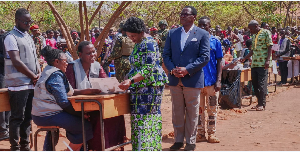
 Malawian President Lazarus Chakwera waits to vote in the general election at Malembo village
Outgoing Malawi President Lazarus Chakwera was hoisted by his own petard, suffering a humiliating election defeat this week largely blamed on his perceived dismal performance in office.
President Chakwera had swept to power in 2020 on the back of promises that he would end poverty and fight corruption. Yet his tenure was characterised by a long-running economic crisis, high inflation, a shortage of basic commodities, and international aid cuts.
His crushing defeat was predicted in opinion polls, but he put on a brave face even as the sentiment among Malawians showed they felt betrayed by the former theologian. Now, Peter Mutharika, the man he defeated in 2020, returned to trounce him.
On Wednesday evening, the Malawi Electoral Commission (MEC) announced that Mutharika garnered 56.8 percent of the votes cast on September 16, against Chakwera’s 33 percent.
The 70-year-old outgoing president had earlier in the day called Mr Mutharika to concede and described his rival’s victory as “historic.”
Five years ago, President Chakwera defeated Mutharika after the Constitutional Court ordered a rerun of the presidential election held a year earlier, after it was found that the results had been changed using correctional fluid known as Tipp-Ex.
Reinford Mwangonde, a former director of governance in the Office of the President and Cabinet in Malawi, said the Malawi Congress Party (MCP) leader had paid the price for promising too much and delivering very little.
Mr Mwagonde said President Chakwera was particularly “punished” by rural farmers, who had been promised cheap fertiliser to boost their yields, but never received any meaningful support during his presidency.
The Food and Agriculture Organisation says the majority of Malawians heavily rely on rain-fed, low-input subsistence farming to meet their food needs.
“The cost of fertiliser was very high, contrary to the promises made by Chakwera,” he said.
“To make matters worse, most Malawians in rural areas could not find maize, and when they found it, it was not affordable. The right to food is fundamental for Malawians, and anyone who messes with it, as Chakwera did, cannot be forgiven, and we have seen the results.”
An Afrobarometer survey just before the elections showed that 58 percent of Malawians were worried about the government’s failure to address food shortages.
In the first half of the year, more than a quarter of Malawi’s population relied on food aid, as the country was still reeling from the Niño-inducedced drought, which decimated crops the previous season.
One of the major promises President Chakwera made in 2019 and 2020, which endeared him to voters, was that he would create a million jobs and lift the majority of Malawians out of grinding poverty.
As he sought a second term in the last election, Malawi remained among the world’s four poorest countries, with over 70 percent of the population living below the poverty line.
Malawi’s economy was in a deep crisis, marked by high inflation, declining living standards, and food insecurity.
According to the World Bank, economic growth rates have dropped from an average of 4.1 percent between 2011 and 2019 to 2.2 percent since 2020. Economic growth rates are below the population growth rate of 2.6 percent, resulting in declining incomes.
Last year, the economic output growth further slowed to 1.8 percent, blamed on an El ENiño-induceddrought, flooding, and foreign currency shortages.
The number of impoverished Malawians has increased by more than three million since 2010, the World Bank says.
Inflation rates are as high as 30 percent, and this has made prices of basic commodities unaffordable for most citizens. Motorists spend several hours or days queuing for fuel.
Mr Mutharika, 85, who lost popularity during his tenure between 2014 and 2020 because of alleged cronyism and failure to deal with corruption, did not have to break a sweat on the campaign trail. The simple message that he repeated at every rally was, “I warned you that you would suffer under Chakwera; haven’t you suffered?”
Mr Mutharika, a former law professor, was credited with improving infrastructure and reducing inflation during his 2014-2020 tenure.
This was the fourth time President Chakwera and Mr Mutharika were crossing swords, after the results of the 2019 contest were annulled by the Constitutional Court due to massive irregularities.
Makhumbo Munthali, a political analyst, said the outcome of the presidential elections showed that Malawians were not willing to reward incompetence.
“The elections show that our democracy is progressing where the citizens are empowered to punish incompetence through the ballot,” Mr Munthali said.
Boniface Dulani, a University of Malawi political scientist, said the election was a referendum on Chakwera, so Mutharika profited from protest votes.
“Malawians have shifted to Mutharika because he is known, and many hope he can at least restore stability. But the real story is that Chakwera failed, and voters punished him.”
He said that despite embarking on visible urban projects such as building roads, the outgoing government failed to meet the basic needs of the majority, who live in rural areas. Soaring prices of fertiliser left farmers disillusioned, he said.
“People felt abandoned on bread-and-butter issues,” Mr Dulani added.
Although the final results of the parliamentary elections are yet to be announced, indications are that Mr Mutharika outperformed his Democratic Progressive Party (DPP), and there could be a need for a coalition with other parties.
Mr Mwagonde, a former senior civil servant, said the new president would have to build an alliance for him to govern effectively.
“The DPP will require the support of willing MPs to support a progressive agenda in Parliament considering that they do not have a majority,” he said. “Malawians have, en masse, voted for DPP at presidential level, but for MPs, they went local, and that tells you that there is an emerging political maturity in the Malawian body politic.”
The Southern African country has been governed by a succession of coalition governments since the advent of multiparty democracy in 1994.
President Chakwera was the leader of the Tonse Alliance, which included his Malawi Congress Party (MCP), and was forged with the late Vice-President Saulos Chilima.
Mr Chilima, who died in a plane crash last year, was the outgoing president’s running mate when they defeated Mr Mutharika. Chilima’s death is seen as having played some role in President Chakwera’s crushing defeat.
The election ended up being a two-horse race between the MCP and DPP despite 17 candidates entering the presidential race. Other contenders were Malawi’s first female president Joyce Banda, current Vice-President Michael Usi,i and former central bank governor Dalitso Kabambe.



Copyright © 1994 - 2026 GhanaWeb. All rights reserved.










