



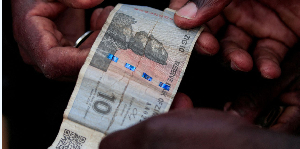
 A trader receives a ten ZiG note from a customer at a vegetable market in Harare, Zimbabwe
Zimbabwe’s plans to drop the US dollar in five years are already causing jitters in an economy that has suffered nearly two decades of currency volatility and bouts of record hyperinflation.
Harare has set 2030 as the target to stop using the US dollar, which has been the dominant foreign currency for the past 16 years, after it was forced to abandon its own.
Zimbabwe first announced on August 6, 2024, that its Cabinet had approved a roadmap to adopt the Zimbabwe Gold (ZiG) as the sole currency. The gold-backed ZiG was launched last year, the country’s sixth attempt at mooting a stable currency in 25 years.
Authorities had envisaged that its introduction would see the country de-dollarize by 2026, but the target has since been moved to 2030.
The central bank concedes that businesses are nervous about the plan to return to a mono-currency regime, so much so that banks are now avoiding long-term lending beyond that date.
John Mushayavanhu, Reserve Bank of Zimbabwe (RBZ) governor, said he would announce a comprehensive de-dollarisation roadmap in November, in what is seen as a desperate attempt to calm nerves.
Dr Mushayavanhu said the roadmap would focus on the need to preserve foreign currency accounts and the existing US dollar-denominated contracts, with considerations made to ensure business continuity and certainty.
The central bank says it is working on modernising the ZiG banknotes by redesigning and producing improved banknotes to increase the acceptance of the new currency.
“The roadmap will undoubtedly encapsulate the need to maintain the current stability, preserve the foreign currency accounts and existing USD-dominated contracts,” Dr Mushayavanhu said as he presented the 2025 mid-term monetary policy statement.
“Consideration will always be made to ensure that there is business continuity and certainty.”
The Confederation of Zimbabwe Industries (CZI), the country’s largest business grouping with membership from the manufacturing, trade, transport, information technology, education, and professional services sectors, said the success of the de-dollarisation strategy would hinge on controlling inflation.
“Low levels of inflation will help build trust in the currency, which might also encourage greater usage of ZiG in transactions,” CZI said. “This could also boost the likelihood of a gradual de-dollarisation process leading to a ZiG mono-currency regime by 2030. The high annual inflation level creates pricing uncertainty, making it difficult for businesses to set prices, forecast costs, or
even negotiate contracts.”
After its 2025 Article IV Consultation in June, an International Monetary Fund (IMF) team said Zimbabwe’s plan to transition to a mono-currency remained unclear. The team advised the authorities to urgently introduce measures to increase demand for the ZiG and institute other reforms if the de-dollarisation plan is to succeed.
“The mission emphasised the need to continue strengthening the monetary and foreign currency market framework in line with IMF staff recommendations,” said Wojciech Maliszewski, head of the IMF team.
“This should be complemented by measures to enhance the demand for ZiG in the domestic economy- most notably, increasing the share of the Treasury’s operations (revenues and expenditures) in ZiG. To reduce any uncertainty weighing on financial intermediation, the authorities should provide more clarity on the implications of the transition plan, including clarifying that the use of a mono-currency will be limited to domestic transactions, allowing for bank deposits to remain dominated in both currencies.”
Over a year since the introduction of the ZiG, the country is still heavily reliant on the US dollar, with the central bank indicating that only 40 percent of transactions are in local currency.
Economic analysts say the new currency is being undermined by the same factors that thwarted previous efforts to re-establish a sole currency. These include a lack of confidence in the banking sector and the local economy, as well as the large scale of the unregulated informal economy, which, according to the World Bank, is the largest in the world.
John Lagat, Imara Asset Management CEO, said the ZiG was destined for extinction just like the other currencies before it because it was being rendered irrelevant by the market.
“There is so little ZiG around – thanks to the very tight monetary policy – that it is easier simply to use US dollar cash or bank cards. We continue to believe that way too much time and energy is spent on dealing with and discussing the ZiG, despite its limited use, that it would be better simply to scrap it and move on,” he said.
He added that the ZiG was largely used in Harare, while in the southern parts of the country, people favoured the South African rand.
“On our recent travels around, it would appear that the South African rand is the favoured currency in the southern parts of Zimbabwe, whilst the US dollar is king further north. Indeed, it is only in the capital, Harare, that the ZiG is used to any extent. The civil servants continue to receive part of their remuneration in ZiG, which they attempt to spend in the formal shops since the formal economy has no use for it.”
According to the IMF, only four out of 85 countries that were surveyed during the 1980 to 2001 period succeeded in de-dollarisation, which makes Zimbabwe’s attempt to return to a mono-currency regime an uphill task.
Zimbabwe started facing acute currency problems in 1997 when the local dollar crashed dramatically that year after Robert Mugabe’s regime paid unbudgeted pensions to former fighters of the country’s liberation struggle.
The crisis deepened when Zimbabwe sent troops to the Democratic Republic of Congo to protect Laurent Kabila’s under siege regime.
A chaotic land reform programme that began in the year 2000 proved to be the final nail in the coffin for the local currency as it led to the country’s international isolation and economic collapse.
By the time Mr Mugabe’s government abandoned the Zimbabwe dollar in 2009 when the inflation rate had peaked at 79.6 billion percent in mid-November. Hyperinflation only ended after the adoption of the US dollar.

Copyright © 1994 - 2026 GhanaWeb. All rights reserved.










