



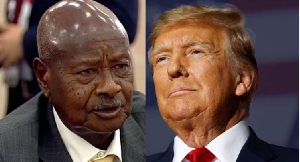
 President Museveni (left) and US President Donald Trump have entered an agreement
Uganda has agreed to accommodate a yet-to-be-specified number of migrants from other African countries deported from the United States as part of President Donald Trump’s crackdown on illegal immigration. Daily Monitor broke the story on August 4 that Kampala was scrambling to strike a deal with the Trump administration to avoid Washington’s proposed full or partial visa ban on Ugandan passport holders and the 15 percent tariffs on all Ugandan exports to the US.
Officials involved in the negotiations told this newspaper that Kampala had until August 1 to agree to a “deal or at least show commitment to the terms” by the set deadline as part of the Trump administration’s push for “deals”– [limited] arrangements on a wide range of issues—with many countries around the world.
Kampala agreed to accommodate African deportees as long as they did not have a prior criminal record. On Tuesday, the American news channel, CBS News, quoting US government documents, reported that Washington had closed the deal with Kampala.
However, it remains unclear how many unwanted migrants Kampala accepted to take in or when deportation flights to Entebbe International Airport will begin. CBS News reported that Washington has reached a similar arrangement with Honduras in Central America.
Since returning to the White House in January, President Trump pledged the largest domestic deportation operation in US history by ramping up deportation flights, including to third countries, and invoking the infrequently-used 1798 Alien Enemies Act.
The New York Times reported in July that deportees had been sent to El Salvador, Peru, Brazil, Colombia, Ecuador, Venezuela, Dominican Republic, Guatemala, Panama, Costa Rica, Nicaragua, Paraguay, Jamaica, and Haiti. In Africa, repatriations have been reported to South Sudan, Lesotho, and Eswatini. According to CBS News, the agreement with Uganda is based on a “safe third country” provision of US immigration law that allows officials to reroute asylum-seekers to countries that are not their own if Washington determines that those nations can fairly hear their claims for humanitarian protection.
High stakes discussions
The US embassy in Kampala declined to be drawn into “private diplomatic negotiations.” “The State Department is doing everything possible to support the President’s policy of keeping Americans safe by removing illegal aliens who have no right to be in the United States,” the embassy told this newspaper in response to our inquiries. The State Minister for International Relations, Mr Henry Oryem Okello, however, dismissed the reports as “lies and rubbish.” “It is true we have ongoing discussions with our friends, the United States, but on visas, tariffs, sanctions, and returning to African Growth and Opportunity Act (AGOA), but there is no discussion whatsoever on illegal aliens from the US,” Mr Oryem said.
He added: “You are talking about cartels, drug dealers, who are not wanted by their own countries. Why would Uganda accept them? It would be very unfair to the general Ugandan population.” Mr Oryem said while Uganda is known globally for its magnanimous refugee policy, which includes giving refugees plots of land to farm and allowing refugees to stay for long periods, but there are limits to it. “You see, the refugees are housed in certain districts, where they live harmoniously with the local communities because it’s the same tribes across borders. How do we deal with those people coming from America? How do you integrate them with communities? We can’t rush into such an arrangement without preparations,” he added.
Asked why CBS News was reporting authoritatively on a matter Kampala was describing as “ongoing negotiations” and whether the deal was closed by State House, Mr Oryem defended that: “In any case, it would be us [Ministry of Foreign Affairs] to sign the arrangement. I don’t know of any deal signed.”
He added: “The US wants to throw out the people you are talking about. Why would Uganda take them in? Under what arrangement? Do we have facilities to host them? I think it would just be unfair to Ugandans.” On the other hand, Uganda’s Permanent Representative to the UN, Adonia Ayebare told Daily Monitor last night that negotiations, including a framework on immigration and adhering to visa requirements, have been ongoing for months.
“We are actively engaged with the US side on tariffs and immigration, but I am not at liberty to go into the specifics,” Ambassador Ayebare said from New York City, US. Ambassador Ayebare is part of the select committee, also comprising Attorney General Kiryowa Kiwanuka and Secretary to Treasury, Ramathan Ggoobi, which President Museveni constituted to negotiate with Washington through their embassy based in Kampala.
Scratch my back diplomacy
The American political digital newspaper, Politico, reported on July 30 that South Sudan, which previously had rejected accepting unwanted migrants, had acquiesced to the proposal and urged the Trump administration to also consider lifting sanctions on senior politicians and military brass accused of corruption, human rights abuses and abetting fighting. In Uganda’s case, several politicians including Speaker of Parliament Anita Among and her husband Moses Mogogo and top military brass are under US sanctions.
President Trump announced 10 percent tariffs on all Ugandan exports to the United States in early April, which were increased to 15 percent in late July. The State Department also in June recommended 36 countries, 25 being African, including Uganda and Tanzania, for full or partial suspension of entry “if they do not meet established benchmarks and requirements within 60 days.” The State Department cited, among other concerns, the lack of cooperative or competent governments by some countries singled out to produce reliable quality identity documents, not cooperating to remove nationals from the US, and citizens of countries overstaying their visas.
While the deal will likely improve the Kampala regime’s diplomatic standing in Washington, the Kyadondo East MP and shadow Foreign Affairs minister Muwada Nkunyingi urged Washington not to drop its guard in pushing the government on good governance and human rights issues. “Commenting about specifics of the deal we have not seen might be speculative, but what we are certain about is that with the Kampala regime’s troubling image on human rights and governance, this is a deal they would rush into to clear their image now that we are heading into the 2026 elections. They did the same thing with Afghan asylum seekers in 2021 when we were fresh from the ugly elections,” Mr Nkunyingi said.
Uganda was among half a dozen countries that Washington courted to offer temporary haven to Afghan asylum seekers who assisted the US and its western allies during the 20-year war, after Taliban fighters, deposed by the American troops two decades ago, ousted Ashraf Ghani’s government and bounced back to power.
The Taliban fighters barrelled to power with limited resistance, capturing Kabul with ease to the world’s surprise, prompting the US to lead the evacuation of trapped local allies and other fleeing citizens. Following high-level discussions and a memorandum of understanding, Kampala committed to take in some 2,000 Afghans.
Despite Washington’s discontentment and sanctions on top Ugandan politicians and military brass in the wake of the blood-stained 2021 election campaigns, the former US President Joe Biden hosted President Museveni to a dinner at the White House after the second US-Africa Leaders’ Summit in December 2022.
Mr Oryem defended that the difference with the arrangement on Afghan asylum seekers is “they were only in transit in Uganda and the US was taking care of their temporary stay in Uganda.” “Even before, Israel tried to bribe us with money to take in Eritrean and Ethiopian refugees and asylum seekers, but we refused. So there is no precedent as you claim,” he added. In 2015, Israel hatched a plot to get rid of unwanted Sudanese and Eritrean asylum seekers by giving them between $8,000-$7,000 to voluntarily move to Uganda and Rwanda in violation of international refugee statutes.
Rwanda similar deal
The United States and Rwanda also agreed for the African country to accept up to 250 migrants deported from the US, the spokesperson for the Rwandan government and an official told Reuters, as President Donald Trump’s administration takes a hardline approach toward immigration. The agreement, first reported by Reuters, was signed by US and Rwandan officials in Kigali in June, said the Rwandan official, speaking on condition of anonymity, adding that Washington had already sent an initial list of 10 people to be vetted.
‘‘Rwanda has agreed with the United States to accept up to 250 migrants, in part because nearly every Rwandan family has experienced the hardships of displacement, and our societal values are founded on reintegration and rehabilitation,’’ said the spokesperson for the Rwandan government, Yolande Makolo. ‘‘Under the agreement, Rwanda has the ability to approve each individual proposed for resettlement. Those approved will be provided with workforce training, healthcare, and accommodation support to jumpstart their lives in Rwanda, allowing them to contribute to one of the fastest-growing economies in the world over the last decade.’’
The White House and State Department had no immediate comment. The Department of Homeland Security referred questions to the State Department.
President Donald Trump aims to deport millions of immigrants in the US illegally, and his administration has sought to ramp up removals to third countries, including sending convicted criminals to South Sudan and Eswatini, formerly known as Swaziland. Rwanda has, in recent years, positioned itself as a destination country for migrants that Western countries would like to remove, despite concerns by rights groups that Kigali does not respect basic human rights
In May, the foreign minister said Rwanda was in the early stages of talks to receive immigrants deported from the United States.

Copyright © 1994 - 2026 GhanaWeb. All rights reserved.










