



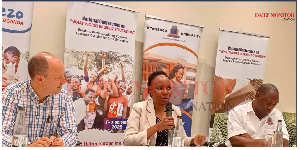
 The Executive Director of Uwezo Uganda, Dr Gorreti Nakabugo (M), briefs journalists
The Executive Director of Uwezo Uganda, Dr Gorreti Nakabugo, has said the high cost of education and harmful cultural practices remain huge barriers to girl-child education in Uganda and need urgent attention to reverse the situation.
“Though progress has been made over the past decade, girls in Uganda and across Sub-Saharan Africa are still faced with enormous challenges to enroll in and complete quality education. Poverty, harmful cultural norms, teenage pregnancies, child marriage, gender discrimination, and lack of safe learning environments are some of the barriers to girl-child education,” Dr Gorreti Nakabugo told journalists during a press conference in Kampala on September 30, ahead of the national conference What Works in Girls’ Education.
The conference, scheduled for October 1 to 3, 2025, under the theme Breaking Barriers, Building Benefits: Evidence and Action for Girls’ Education, will bring together experts from 20 countries.
According to Dr Nakabugo, the cost of education is a key determinant of whether children enroll, stay in school, and complete their education cycle.
“Girls are forced to drop out especially at the lower levels of education, which translates into a vicious cycle of poverty. We have eight to eleven themes under which different researchers and practitioners are going to present papers during the conference. One of them is the issue of policy and financing,” she said.
Despite Uganda’s free education policy, extra charges, such as contributions to teachers’ salaries even when they are on government payroll, remain a challenge. In addition, many parents cannot afford the fees charged by private schools.
Available records indicate that at least 30 percent of parents in Uganda borrow money to pay school fees for their children.
Associate Professor George Wilson Kasule, Dean of the School of Education at Kyambogo University, said parents and guardians also have a responsibility to ensure children stay in school.
Mr Emmy Zoomlamai Okello, Country Lead for the Regional Education Learning Initiative (RELI) -Africa Uganda Chapter, said misinterpretation of the Universal Primary Education (UPE) and Universal Secondary Education (USE) policies by leaders has misled parents.
“The leaders are preaching to the parents that we have free education, but this is universal education, which is for everyone. What needs to be done is to engage parents more closely so that they understand what the policy means when it comes to universal education. That alone is costing the country much in terms of children not learning and lagging behind in some of the competencies in literacy and numeracy at the foundation level,” he said.
Prof Richardo Sabates from the University of Cambridge said intentional collaborative efforts must be promoted to address barriers in the education system to ensure both boys and girls access quality education needed to drive human capital development.

Copyright © 1994 - 2026 GhanaWeb. All rights reserved.










