



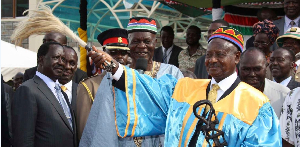
 Prime Minister Raila Odinga looks on while Ugandan President Yoweri Museveni is crowned as Luo elder
In early 2012, Raila Odinga and Uganda’s President Yoweri Museveni met at the former prime minister’s home in Kisumu, where they conceived the idea that would later become known as the Coalition of the Willing (CoW) –a breakaway effort from the East African Community (EAC) that would set the tone for the region’s integration.
However, Odinga did not live to execute, as the presidency eluded him.
As Mwai Kibaki’s presidency was coming to an end, Museveni sought an ally in the influential Kenyan prime minister, who was then seen as a potential president, to drive the EAC’s push towards a political federation, even if it meant risking alienating Tanzania and jeopardising Kampala’s relations with Dodoma.
But the Ugandan leader also had personal issues to get off his chest. He had had frosty relations with Odinga after Kenya’s 2007 presidential election, whose result caused violence that shook the region, and he needed a sit-down to mend their relationship.
Milking a new idea
According to Michael Mukula, a long-time friend of Odinga and a ruling party ideologue in Uganda, who spoke to The EastAfrican, the underlying reason for Museveni’s February 18, 2012 trip to Kisumu, at the invitation of Odinga to launch and fundraise for the Great Lakes University’s Kisumu Education Trust, was the desire to smooth things over and thrash out the breakaway confederation.
In 2010, while serving as the eastern region chair of Uganda’s ruling National Resistance Movement, Mukula brokered the first meeting between Odinga and Museveni, and was involved in subsequent meetings between the two, including the Kisumu CoW talks.
According to Mukula, the discussions centered on testing whether the comprehensive approach that the EAC was using to establish a political federation, agreed upon by all member states, would work.
The doubts of the two leaders were based on the overly cautious approach shown by some member states, such as Tanzania, towards expediting processes that would lead to the fourth and final pillar of integration.
At the time, the EAC members were Kenya, Uganda, Tanzania, Rwanda, and Burundi.
“If Uganda and Kenya, along with one or two more countries, step forward to initiate the political federation, especially after the elections in Kenya, it would gain momentum,” Mukula recalled. The Kenyan general election was held in 2013.
From CoW to cooperation
Odinga and Museveni discussed the idea of a lean federation based on the principle of variable geometry, which would allow countries to cooperate at different speeds, but only if the political federation protocol had been signed.
Experts warned not only about the practical difficulties of achieving it, but also the negative perception it would create among the other member countries, as it would contradict the Treaty establishing the Community.
Moreover, considering that Uganda was one of the poorest implementers of the Customs Union Protocol, the move would be seen as jumping the gun. This, along with the continued existence of non-tariff barriers in other partner states, would create dissonance.
At the time, Yona Kanyomozi, a former member of the East African Legislative Assembly, said that the CoW was an approach President Museveni favoured and had pushed at other forums, borrowing from the United States, whose federation began with only 13 of the current 50 states and the District of Columbia.
The Ugandan leader had made this comparison when responding to the report of the 2004 Amos Wako Committee, which was set up to study public views and perceptions towards fast-tracking political federation.
Museveni rankled Odinga in 2007, when he became the first president to congratulate Mwai Kibaki on an election that Odinga claimed had been rigged, and which the majority of people had disputed, including Samuel Kivuitu, the head of the electoral commission, who infamously said he did not know who had won.
When deadly post-election violence broke out in December 2007 and early 2008, unconfirmed reports claimed that Uganda had sent troops across the border.
Later, in 2009, Museveni was reported to have made disparaging comments about Raila’s Luo tribe after some people vandalised the Kenya-Uganda railway line.
“Our visit to Kenya is based on our need to enhance the East African Political Federation and the unity [in the region],” Mukula said at the time. “We believe that the 120-130 million people in East and Central Africa can be united, and it is the political will that we must now be able to field in order to ensure that the people of East Africa who were disenfranchised and balkanised in 1884-6 in the Berlin Conference rediscover, reorganise and redirect their focus towards building a united East Africa.”
Odinga lost the 2013 presidential race to Uhuru Kenyatta, and, with it, the initiative to be the co-driver of the lean federation. In June 2013, Kenyatta, Museveni and Rwanda’s Paul Kagame made public what had been crafted by Odinga and Museveni.
While the three countries have yet to evolve into a political federation, they have undertaken integration projects that are considered crucial to economic growth, infrastructure improvement, trade facilitation, and cooperation.
Read: Pan-African-in-chief: Inside Raila Odinga’s dream for the continent
Key projects include a standard gauge railway, roads, ports, and ICT projects to connect the region’s landlocked countries to the port of Mombasa in Kenya, as well as energy infrastructure to power the region.
The software projects undertaken by the CoW member states include defence and security cooperation, as well as the establishment of a single customs territory, a model system for revenue collection in an integrated economic bloc.

Copyright © 1994 - 2026 GhanaWeb. All rights reserved.










