



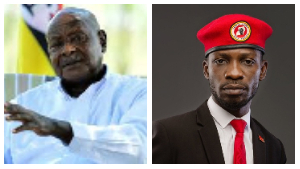
 A photo montage of inchttps://cms.ghanaweb.com/beheerumbent President Museveni (L) and Bobi Wine (R)
Uganda's President-elect Yoweri Museveni on Sunday said the opposition survived the January 15 presidential election only because millions of ruling party supporters failed to turn out to vote, arguing that full mobilisation of the National Resistance Movement (NRM) would eliminate any meaningful political challenge.
Museveni said nearly 10 million NRM members did not participate in the vote despite the party claiming more than 21 million members nationwide, with at least 18 million eligible voters.
He added that the ruling party obtained almost eight million votes but would have performed far better had all its supporters turned out, noting that the opposition had benefited from low participation among NRM members.
Museveni was declared the winner with 7,946,772 votes, representing 71.65 percent of ballots cast, securing a seventh five-year term.
His closest challenger, opposition leader Robert Kyagulanyi, popularly known as Bobi Wine, received 2,741,238 votes, or 24.72 percent.
The Electoral Commission said turnout stood at 52.50 percent of Uganda's 21.6 million registered voters, with 275,353 ballots recorded as invalid.
Without offering concrete evidence, Museveni suggested that many of the nearly 300,000 spoiled votes belonged to NRM supporters and said the ruling party would investigate why millions of its members failed to vote.
He attributed his victory to what he described as a return to the founding principles of the NRM, citing peace, national unity, and economic recovery as decisive factors shaping voter behaviour.
Museveni recalled the 1996 elections, arguing that public support at the time was driven by a disciplined army, the absence of extrajudicial killings, the removal of sectarian politics, and improvements in basic living conditions following years of instability.
"If you remember the elections of 1996, people were not willing to listen to any story from the opposition like Ssemogerere because at that time we had dealt with the major needs of the army. These were: a disciplined army which would not kill people… no extrajudicial killings, and people were very happy with that. Number two was that NRM had removed sectarianism. Then, we had started rehabilitating the infrastructure and solved the issue of lack of supplies like soap," he said.
According to Museveni, a similar trend is emerging again, particularly in northern and eastern Uganda, where peace remains a central concern for voters.
"This atmosphere of maximum unity is coming back, and in many areas, it is mainly because of peace. In northern Uganda and some parts of eastern Uganda, some people were asking the opposition, 'What? You want to bring back war?' Then, skilling hubs and the Parish Development Model (PDM) have also given people hope," he added.
During his election campaign, the president invoked Libya as a cautionary example, saying many Ugandans, including opposition members, had privately expressed fear of instability and rejected actions that could plunge the country into chaos.
Although he did not name or indicate the number of people, he said he secretly met some opposition figures at the State Lodge in Nakasero on January 13, ahead of the election, and that they told him they did not want Uganda to end up like Libya. He said this fear played a role in limiting post-election unrest.
"It's not just the security forces maintaining peace but also the Ugandans, including NUP members. Yes, many of them have grievances, but once you go beyond, they will say no. In fact, most of those who came to me said they don't want our country to be like Libya," Museveni, who captured power in 1986, explained.
In his January 1 New Year address, opposition leader Bobi Wine, who has strongly rejected Thursday's election, reacted to Museveni's end-of-2025 address accusing NUP of working for foreigners to destabilize the country, saying: "I don't look at Gen Museveni with anger. I look at him with pity."
He added, "By his age, he is being fed fake intelligence."
The 2026 election was conducted amid widespread biometric voter verification failures and a nationwide internet blackout, developments that opposition leaders cited in rejecting the outcome.
Bobi Wine said on Saturday that he had self-evacuated from his residence amid heightened security deployment. His whereabouts remained unclear by Sunday evening; however, his social media platforms continued to share posts denouncing the re-election of the veteran ruler.
Museveni, who first took power in 1986 after leading a five-year guerrilla war, said peace remained the foundation of Uganda's political and economic progress ahead of his swearing-in, traditionally set for May, if results hold.
Background
Libya remains fragmented more than a decade after Muammar Gaddafi's fall, with rival administrations in Tripoli and the east competing for power amid militia influence.
Repeated UN-backed efforts to unify the country and hold elections have stalled, while foreign actors continue to shape the conflict.

Copyright © 1994 - 2026 GhanaWeb. All rights reserved.










