



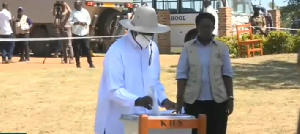
 Museveni is the President of Ugandan
President Museveni on Sunday hinted at plans extending beyond his newly secured five-year term, signalling that preparations for the 2031 elections had already begun as he warned public servants that governance failures would no longer be tolerated.
Speaking on January 18 from his Rwakitura residence after being declared winner of the presidential election, Museveni said his government must unite the ruling National Resistance Movement’s estimated 21 million members to secure future electoral dominance.
“Once we do these things, we shall unite all our 21 million members so that when we go for elections in 2031…” Museveni said in his victory speech, stopping short of explicitly confirming whether he would again be a presidential candidate.
If results hold, by the end of the new five-year term, Museveni, who turns 82 in September, would be approaching 90 years of age, having ruled Uganda since 1986 following a five-year guerrilla war.
His Sunday victory speech remarks linked the ruling NRM party’s political survival directly to governance performance, with the president arguing that poverty, corruption and poor service delivery had fuelled unrest during his outgoing term.
“I will be very harsh in this term; you will have to forgive me,” Museveni said, warning officials over corruption, theft of drugs from public hospitals, decaying roads, land grabbing and failures in the justice system.
“Small potholes come, and then they grow. What is happening to the Ministry of Works? What are they doing? Some of the roads, when they are still new, are very good, like the roads in Karamoja and Bunyoro. Such roads must be maintained. I’m glad many villages have safe water now, but we’re going to have all the villages get more water for production and irrigation. On the jobs—not government jobs but jobs from agriculture, manufacturing, artisanship and so on. Once we do these, we shall unite all our 21 million members so that when we go for elections in 2031…” the president highlighted his five-year-term priorities.
Museveni said he had started negotiating with East African leaders to create a market in line with his bid for an economically and politically integrated region.
“…because you see the economy is growing so much; the production is so big, and the internal market is not enough. Yes, if people become richer with more money in the pocket, they can buy more internally, but we also need the external market,” he said.
Museveni added that, “I have already started speaking to our EAC leaders. This morning I spoke to Ruto. I’m going to speak to Samia [Tanzania] and other leaders about the EAC so that we make that market free so that we can sell easily without restrictions.”
NRM and opposition abusers
The Ugandan leader described poverty as the central driver of political manipulation, saying poor households were vulnerable to bribery and unrest.
“These opposition members, but even some NRM people, are abusers of our people. One of the plans was to get money from outside and give bribes to voters. A bribe of Shs10,000 is an insult, but our people can accept it because they are poor. In order to stabilise the country, we must end poverty in these households,” he noted.
“In this new term, we should have no compromise. All these homesteads, unless they want, must have income to start generating money so that they are not poor. We must reverse the culture where people are in need and always asking or begging to a culture where they have a surplus and are always giving to political parties, a church, mosque, etc. It is that poverty that opens the gate for all problems,” Museveni remarked.
Museveni maintained that his new government would intensify income-generating programmes like the Parish Development Model, insisting that all households must transition into the money economy “unless they don’t want.”
Governance failures in education, health and infrastructure have repeatedly triggered protests during Museveni’s final term—unrest that authorities often swiftly contained through security deployments and arrests.
‘No to sharing oil income’
The president also strongly rejected opposition proposals to share oil revenues directly with local governments, arguing that Uganda’s oil, expected to start flowing this year, would last only about 20 years and should instead fund long-term investments.
“We shall have money to deal with infrastructure like the railway, power stations and some of the roads, plus science education… Not all roads, because I don’t want this money to be put in things which are not long-lasting. When Bobi Wine went to Hoima, he said the oil money would be shared. I told the Banyoro that this oil is not comparable to agriculture,” he said, adding:
“This particular oil will last only 20 years. We may find other oil in the Albertine Valley, but also in other areas like Karamoja, Kyankwanzi and Lango.
“We may find it. So what will happen after 20 years? If you care about your country, the money from this oil, which is exhaustible, should be used to do things which will stay long-term. If you say we give more money to local government people, they will share the money among themselves and not do anything long-term, and that will be the end.”
Museveni said the Banyoro had listened to his appeal and responded accordingly.
“The Banyoro are not stupid people, and they listened. You saw how they voted massively because I was able to explain to them. Remember, there are countries like Japan which don’t have oil but make cars, and we stupid people buy them. We want our young people to master science… Things will be much easier because we shall have much money to deal with these investments,” he observed.
Uganda’s Electoral Commission declared Museveni the winner of the January 15 election with 71.65 per cent of the vote, extending his rule to nearly 40 years amid allegations of irregularities, biometric failures and an internet blackout. Opposition leaders have rejected the result, arguing that governance failures and repression remain unresolved.

Copyright © 1994 - 2026 GhanaWeb. All rights reserved.










