



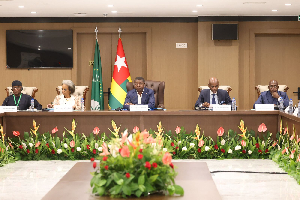
 The meeting was led by Faure Essozimna Gnassingbé, President of the Council of the Togolese Republic
In Lomé, Togo has chosen to break with declaratory diplomacy surrounding the crisis in eastern Democratic Republic of the Congo (DRC).
The high-level meeting held on 17 January, 2026, marks a clear determination to reorganize African action and test its real effectiveness. At the heart of this initiative lies a simple yet decisive requirement: to deliver results.
As eastern DRC remains one of the continent’s most persistent conflict theatres, Lomé asserted itself on Saturday, 17 January, as a space for political clarification. By hosting this high-level meeting, Togo did not seek to multiply symbols, but rather to refocus African action on its recurring weak point: implementation.
Led by Faure Essozimna Gnassingbé, President of the Council of the Togolese Republic and the African Union’s designated mediator, the Lomé process fits within a logic of accountability. The objective was not to introduce yet another framework, but to question the continent’s collective capacity to organize its peace mechanisms and assume their political consequences.
A Diplomacy of Method
The 17 January meeting was part of a carefully prepared diplomatic build-up. The previous day, a technical session aligned the actors involved, clarified roles, and structured priorities. This preparatory phase reflects a deliberate break from usual practices: here, method precedes announcement, and coordination takes precedence over staging.
In an African environment marked by the coexistence of multiple mediation initiatives, Lomé advances a clear position dispersion weakens action.
The proliferation of formats around the Congolese crisis has resulted in diluted responsibilities and a loss of strategic clarity. In response, Togo advocates a simplified, guided, and coherent architecture, capable of linking political decision-making, institutional coordination, and operational implementation.
This approach reflects a firm conviction: Africa lacks neither diagnoses nor commitments, but rather continuity in action. The Lomé meeting therefore seeks to bridge the gap between diplomatic discourse and concrete outcomes on the ground.
Political Accountability and a Results-Driven Imperative
The message delivered in Lomé was unequivocal. Peace can no longer be assessed by the number of meetings held or communiqués issued. It must be judged by tangible outcomes—population security, access to essential services, territorial stabilization, and the restoration of trust.
From this perspective, African mediation is being called upon to change course. The task is no longer to innovate institutionally, but to ensure that existing mechanisms function with rigor. Clarifying decision-making chains, strengthening coordination among actors, and embedding action over time become the minimum conditions for credibility.
By positioning Lomé at the center of this dynamic, Togo adopts a demanding posture that of a facilitator who rejects comfort diplomacy and holds each actor accountable.
The 17 January meeting thus emerges as a pivotal moment, not because of its symbolism, but because of the scrutiny it applies to African action itself.
For the continent, the challenge is now clear: to demonstrate that peace can be conceived, led, and consolidated by Africa not merely as a principle, but as a sustainable practice.

Copyright © 1994 - 2026 GhanaWeb. All rights reserved.










