



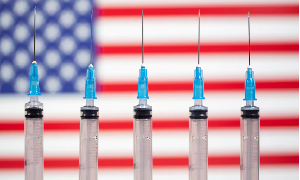
 Syringes are seen in front of a displayed U.S. flag in this illustration taken Nov.10, 2020
A Trump-administration-funded study into the effects of hepatitis B vaccines on newborns in Guinea-Bissau has not been cancelled but will undergo further ethical review, African health officials said on Thursday, the latest twist in a tug-of-war over the research.
The confusion, which follows criticism of the study, highlights the difficulties faced by global health officials in navigating the policies of vaccine sceptic Robert F. Kennedy Jr, the U.S. health secretary appointed by President Donald Trump.
The Guinea-Bissau research will investigate potential "non-specific effects" of vaccines, including skin disorders and neurodevelopmental disorders, such as autism, according to details of the study, opens new tab posted online.
Critics note that extensive research has already shown no link between neurodevelopmental disorders, like autism, and vaccines. Kennedy has promoted the idea of a link.
Scientists have argued the study is unethical because some of the newborns involved would not get the vaccine, which is known to be safe and save lives, in a country with high rates of hepatitis B, which transmits commonly from mother to child during birth and can cause liver failure and cancer.
The study's researchers at the Guinea-Bissau-based Bandim Health Project, part of the University of Southern Denmark, say the project is ethical because the vaccine is not yet administered at birth in Guinea-Bissau, where the first dose is given at six weeks. All the babies involved would get that dose.
WHAT HAS HAPPENED TO THE STUDY?
Last week, the Africa Centers for Disease Control and Prevention said the hepatitis B vaccine study had been cancelled, while the U.S. health department said that it would proceed as planned.
The director general of the Africa CDC, Dr. Jean Kaseya, told journalists on Thursday that the study is under discussion after Guinea-Bissau officials asked Africa CDC for support with a further ethical and technical review of the trial.
Guinea-Bissau's director general for public health, Armando Sifna confirmed at the same press conference that the trial was on hold pending further review.
An official from the U.S. Health and Human Services Department had earlier disputed that there was any postponement.
"The study is proceeding as planned, and we continue to work with our partners to finalize the study's protocols," the official said by email when asked to comment on the further ethical review on Wednesday after an Africa CDC official told Reuters it was due to be announced.
The project researchers were not immediately available for comment.
WORLD HEALTH ORGANIZATION RECOMMENDS NEWBORN DOSE
The U.S. Centers for Disease Control and Prevention is funding the $1.6 million study in Guinea-Bissau, which the U.S. health department said would help inform global vaccine policy and would be done to the highest ethical standards.
The Bandim project has conducted years of research in Guinea-Bissau, and the researchers say their work aims to better understand the full impact of vaccines, both positive and negative. Some of it has been questioned by other scientists, opens new tab, while Kennedy cited Bandim's research to justify cutting U.S. funding to Gavi, the vaccine group.
In December, the U.S. scrapped a universal recommendation for American newborns to receive hepatitis B shots that had been in place for decades, saying families and their doctors should decide whether to give any doses to their children. Leading medical organizations said the move will expose more children to harm.
A critic of the Guinea-Bissau study, Paul Offit, director of the Vaccine Education Center in the United States and an attending physician in the Division of Infectious Diseases at Children's Hospital of Philadelphia, welcomed its delay.
"It's not an ethical study," he told Reuters by telephone, adding that he did not see how it could be redesigned to make it ethical.
The World Health Organization recommends that newborns get the hepatitis B vaccine, especially in countries with a high prevalence, like Guinea-Bissau, where 19%, or one in five people, are estimated to have the disease.
The country, which underwent a coup in December, offers the vaccine at six weeks old but struggles to get vaccines to all who need them and plans to add the newborn dose in 2028.
"No participating child receives fewer vaccines than they would outside the study," said Christine Stabell Bell, the chair at the Bandim Health Project.
Vaccination will be offered to any mothers who are known to be infected with hepatitis B, said Frederik Schaltz-Buchholzer, the lead investigator from Bandim, although many mothers are unaware of their status, given gaps in testing in Guinea-Bissau.
He estimated that 220-270 babies would be saved from hepatitis B infection because of the study.
Johns Hopkins University says thatabout 90% of babies exposed to hepatitis B, opens new tab at birth or in their first year of life, develop a chronic infection, and a further 15% to 25% die early of related liver failure or cancer as a result.
Denmark, the United Kingdom, and other countries also only give the newborn dose where a mother has tested positive for hepatitis B, but levels of the disease are much lower in those countries than in Guinea-Bissau, and healthcare is more widely available.

Copyright © 1994 - 2026 GhanaWeb. All rights reserved.










