



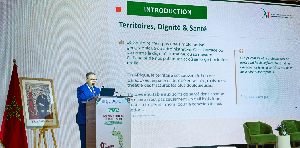
 Professor Youns Bjijou speaking at an event
Africa must make the current decade a health renaissance anchored in sovereignty, equity, and territorial inclusion, a Moroccan health expert has urged at the opening of the 9th FAAPA General Assembly.
Professor Youns Bjijou, Deputy Director of the Mohammed VI Foundation for Science and Health, made the call during a keynote presentation at the opening ceremony of the two-day Assembly in Marrakech.
The General Assembly, opened by President of the Atlantic Federation of African Press Agencies (FAAPA), Mr Arif Fouad, is being held on the theme: “Territorial Inclusion and Spatial Justice: African Press Agencies at the Heart of the Continent’s Transformations.”
Prof Bjijou said achieving health sovereignty for all African citizens was essential to safeguarding dignity, national cohesion, and continental security.
Africa, he noted, was undergoing a health transition marked by a double epidemiological burden.
Persistent infectious diseases with a rapid rise in non-communicable diseases was placing sustained pressure on fragile health systems, he noted.
“According to data from the World Health Organization (WHO) and the Africa Centres for Disease Control (Africa CDC), Africa accounts for about 94 per cent of global malaria cases,” he cited.
“Additionally, 65 per cent of people living with HIV and 76 per cent of malaria-related deaths among children under five.”
The WHO and Africa CDC also report a sharp rise in cancers, diabetes and cardiovascular diseases across the continent, driven largely by urbanisation, ageing populations and lifestyle changes.
Comparative indicators from the two institutions show very low health spending per capita, critical shortages of medical personnel and a heavy dependence on imported medicines and vaccines.
It is estimated that between 70 and 90 per cent of medicines used in Africa are imported, while more than 99 per cent of vaccines come from outside the continent, exposing countries to serious vulnerabilities during global health emergencies.
Prof Bjijou, therefore, emphasised that health sovereignty required a paradigm shift from passive dependence to active local production, innovation and secure supply chains.
He described resilient health systems as essential public goods and pillars of national security.
African institutions, should, therefore, not treat health not as a budgetary cost but as a strategic investment to build resilient, equitable and sovereign health systems across the continent.
Morocco, he said, under the leadership of King Mohammed VI, had placed health sovereignty, territorial equity and citizen-centred care at the core of its development model.
The reforms include the establishment of Territorial Health Groups, which decentralise governance, strengthen proximity care and integrate digital systems to improve efficiency and accountability.
The Mohammed VI Foundation for Science and Health supports these reforms through excellence in healthcare delivery, training, research and innovation, extending state action in a flexible and responsive manner, he explained.
Integrated hospital-university complexes have also been developed in Dakhla, Agadir, Marrakech and Rabat, alongside the Mohammed VI University of Health Sciences.
It trains professionals in medicine, pharmacy, nursing, public health and biomedical engineering.
These initiatives, he pointed out, formed part of Morocco’s broader commitment to support continental efforts through the sharing of expertise, capacity building and African-led scientific solutions.
The African Academy of Health Sciences and the Dakhla Declaration are other initiatives.
Prof Bjijou urged African media, particularly press agencies, to help advance health sovereignty by translating policy into lived realities, combating misinformation, and giving voice to underserved territories.
This responsibility aligned closely with the FAAPA General Assembly theme, which placed territorial inclusion and spatial justice at the heart of Africa’s transformation agenda, he observed.

Copyright © 1994 - 2026 GhanaWeb. All rights reserved.










