



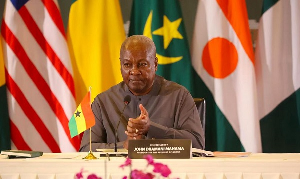
 President John Dramani Mahama
President John Dramani Mahama has called for a renewed and inclusive framework for regional security cooperation to confront terrorism, violent extremism and transnational crime.
He warned that peace, stability and prosperity in West Africa cannot be achieved through isolated national efforts.
President Mahama said the region had reached a defining moment where unity, trust and collective responsibility must override fragmentation and mistrust if shared security threats were to be addressed effectively.
The President was speaking at the opening of the Summit of Heads of State and Government, held as part of the High-Level Consultative Conference on Regional Cooperation and Security in Accra.
The conference focused on addressing terrorism, violent extremism, transnational organised crime and related challenges in West Africa and the Sahel. It is expected to culminate in renewed commitments by Heads of State to strengthen regional solidarity, coordination and collective action.
Welcoming fellow leaders, intelligence chiefs and key stakeholders, President Mahama said the conference was convened to provide an opportunity not only to reflect on the region’s challenges but also to renew collective resolve to act decisively and in solidarity.
He said Ghana initiated the consultative process to help forge a common consensus that responds to shared threats while respecting the sovereignty and political choices of all states in the sub-region.
The President recalled the establishment of the Accra Initiative in 2017 as a cooperative framework to counter the spread of terrorism and violent extremism.
He noted that its effectiveness had been undermined in recent years by political realignments and mistrust following the emergence of the Alliance of Sahelian States.
Despite these developments, he stressed that terrorism and violent extremism remained common threats to all countries, regardless of alliances.
President Mahama cited a recent violent attack in Niger as a stark reminder of the existential danger confronting the sub-region and expressed solidarity with the government and people of Niger.
He described the Accra meeting as a first step towards rebuilding consensus and drawing all countries in the region into a renewed cooperative effort against insecurity.
The President said that when he assumed office in January 2025, he emphasised renewal as both a necessity and a duty, grounded in honest engagement with reality, restoration of confidence in institutions and the rebuilding of inclusive and resilient societies.
These principles, he said, extended beyond Ghana’s borders, as the destinies of West African states were inseparably linked by geography, history, culture and shared human experience.
According to President Mahama, progress in one country strengthens the collective, while instability in another reverberates across borders, making it neither realistic nor sustainable for any state to pursue security or prosperity in isolation.
He described West Africa as a deeply interconnected community shaped by centuries of trade, migration and cultural exchange, where the movement of people, goods and services sustains millions of livelihoods.
At the same time, he said this interdependence meant that threats such as violent extremism, transnational organised crime, unconstitutional changes of government, youth unemployment and climate-induced vulnerabilities spread easily across borders.
These challenges, he noted, were fluid, asymmetric and interconnected, demanding an integrated approach to human security, preventive diplomacy and collective resilience.
President Mahama acknowledged the important role played by ECOWAS and other regional mechanisms in dialogue, mediation, peacekeeping and early warning, but said coordination gaps, overlapping mandates and limited follow-through had sometimes weakened outcomes.
He stressed that the objective of the consultative conference was not to replace existing ECOWAS structures, but to reinforce, adapt and better coordinate them to respond to today’s realities.
President Mahama, who chaired the summit, said the proposed renewed framework would prioritise preventive diplomacy and early action, integrate security responses with development and governance, and place the well-being of citizens at the centre of policy.
He added that peace and security could not be sustained by force alone, stressing that education, job creation, infrastructure development and inclusive growth were essential to reducing vulnerability to radicalisation.
Speaking at the summit, President Julius Maada Bio of Sierra Leone warned that terrorism in West Africa had entered a dangerous phase, with armed groups no longer testing states but actively attempting to dismantle them.
He said more than half of all terrorism-related deaths worldwide now occurred in the region, describing the situation as a global emergency that required decisive and coordinated regional action.
President Bio said that behind every terrorist attack were displaced families, traumatised communities, violated women and girls, and young people drawn into cycles of violence, realities worsened by poverty, weak institutions and climate shocks.
He said fragmented and reactive responses were no longer acceptable, stressing that intelligence sharing, mobility and logistics were essential to effective regional security cooperation.
He called for a unified and coherent regional response, urging stronger coordination among existing initiatives and joint security arrangements.
President Bio also cautioned that military action alone would not deliver lasting peace, emphasising the need for governance reforms, inclusive development and economic opportunities to address the root causes of extremism.
President Joseph Boakai of Liberia said recent developments in Niger were a rude awakening that underscored the urgency of the conference.
He thanked President Mahama for the initiative and said Liberia fully supported the effort, noting that the country understood the devastating costs of violent conflict from its own history.
President Boakai said wars and violent conflicts left nations wrecked and development stalled, with no respect for borders.
He said the conference was taking place at a time of global disorder and uncertainty, with threats ranging from terrorism and violent extremism to cybercrime, illicit mining, arms proliferation, human trafficking and climate-driven resource conflicts.
He stressed that Liberia remained committed to multilateralism and regional cooperation, describing collective security as the only viable path to stability.
As a non-permanent member of the United Nations Security Council, he said Liberia continued to advocate regional approaches to peacebuilding that draw in neighbouring states and regional organisations to address both epicentres of violence and their support networks.
President Boakai reaffirmed Liberia’s commitment to implementing the recommendations emerging from the conference, warning that no country could be secure if its neighbours were engulfed by terror.
He urged leaders to act without delay, stressing that West Africa would either secure itself together or be destabilised apart.

Copyright © 1994 - 2026 GhanaWeb. All rights reserved.










