



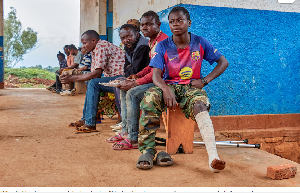
 Wilondja Mukula, a member of the Wazalendo militia sits with other patients after the treatment
Nurses at the general hospital in Fizi, a town ringed by steep highlands in eastern Congo’s South Kivu province, hurried the wounded soldier into surgery after he was brought in slumped on the back of a motorbike.
He was shot in both legs on the front line in the mountains north of town, where clashes between the army and rebel groups have surged in recent weeks.
The fighting, unfolding away from urban areas and largely overlooked by international mediators, is drawing in more forces from all sides in the war in eastern Congo, with the potential to further complicate efforts by the Trump administration to bring peace and Western minerals investments to the region.
REBELS PUSH SOUTH AFTER CAPTURING KEY CITIES
Earlier this week, the AFC/M23 rebel group invoked the fighting as justification for a drone attack on Kisangani airport, hundreds of kilometres from the front lines, calling it retaliation for government aerial attacks on South Kivu villages. Congo's army has not commented on the drone strike or on the rebels' claims that it attacked villages.
Meanwhile, the casualties continue to mount.
The hospital in Fizi, supported by the International Committee of the Red Cross, was caring for 115 wounded patients when a Reuters journalist visited at the end of January, more than four times its 25-bed capacity.
"Most of our patients have injuries in their upper or lower limbs, they often arrive with wounds that are already infected because of limited facilities on the frontline," Richard Lwandja, a surgeon, said.
AFC/M23 staged a lightning advance early last year and in February 2025 seized Bukavu, the capital of South Kivu, before advancing southward again in December to briefly take Uvira on the border with Burundi.
The rebels withdrew a few days later under pressure from the United States, which brokered a peace accord between Congo and Rwanda in June.
The United Nations and Western powers say Rwanda backs AFC/M23, even exercising command and control over the group, though Rwanda denies this.
The recent fighting has centred on the highlands around Minembwe in Fizi territory, where the army has launched an operation against AFC/M23 and its local ally, the Twirwaneho, a group formed by Congolese Tutsi known as Banyamulenge.
"The highlands around Uvira are highly strategic: whoever controls them has access to major towns in the lowlands," said Regan Miviri, an analyst at the Ebuteli research institute in Kinshasa. "And because the area is so remote, the fighting there draws less attention and less diplomatic pressure."
The government's priority, he said, was to secure Uvira and stop the conflict from extending towards Tanganyika and Katanga, areas that include some of Congo's most important mining centres.
DIPLOMACY STRUGGLES TO KEEP PACE WITH FIGHTING
AFC/M23 has framed its presence in South Kivu's highlands as an effort to protect the Banyamulenge, while Kinshasa has accused the coalition of exploiting long-running tensions between communities over land, cattle, and local representation.
The escalation in fighting comes as Congo and AFC/M23 agreed in Doha this week to activate a Qatari-mediated ceasefire monitoring mechanism. A U.N. team is expected to deploy to Uvira in the coming days.
At Fizi's hospital, staff say the flow of wounded shows no sign of easing, and they worry they will not be able to cope much longer.
"Roads are often impassable, and supplies run out," said Robert Zoubda, a Red Cross nurse. "If this continues, we'll have to install more tents."

Copyright © 1994 - 2026 GhanaWeb. All rights reserved.










