



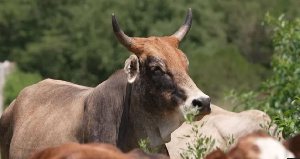
 Foot-and-mouth has now affected almost the whole country
The peace of lush, rural landscape in South Africa's KwaZulu-Natal province disguises the anxiety that is stalking the land.
This is the epicentre of a foot-and-mouth disease outbreak that has – in the past year – swept across eight of the country's nine provinces, devastating animal herds, with many cattle being killed to halt its spread.
Farmers are fearful that they could lose their livelihoods altogether as other countries take action and stop the import of South African animal products.
The highly contagious virus, passed through direct animal contact or in contaminated feed or water, causes painful blisters inside the mouth and under the hooves of animals such as goats, cows and sheep, and can lead to lameness and problems feeding. It lowers their yields and also sometimes kills young animals but is not harmful to humans.
The current situation in South Africa has now been declared a national disaster. Despite being a relatively small part of the economy, agriculture is a key employer in rural areas and in normal times provides vital foreign exchange through meat and livestock exports.
KwaZulu-Natal is the heartland of the country's dairy industry.
Farms, with their cows grazing on the grass, dot the green hills lining the Mooi River.
Here, biosecurity measures such as disinfection points at farm entrances designed to prevent the spread of the virus as well as roadblocks and restrictions on the movement of cattle, have not always worked.
The herd at the large commercial farm run by Carol Houston and her husband became infected last month.
"We received a call from our staff that 50 cows were showing signs of mastitis and were hobbling, struggling to walk. We did all we could to keep the disease out and spent roughly $380 (£280) per cow on treatment [including antibiotics]," Houston tells the BBC.
"My milking herd's normal output dropped from 14,000 litres of milk per day to 9,000 within days of the outbreak because infected cows eat less and struggled to produce milk."
Milk production stayed at that level for about two weeks until the infection was cleared from her herd of 2,200 cattle.
Now, as the cows line up to be milked, workers check each one for symptoms of foot-and-mouth disease.
With the afternoon sun beating down while the cows snort and moo, the workers inspect and clean the animals' teats, which are then attached to milking equipment. The machines gently suck out the milk and transfer it to large containers.
Houston, who has 35 years' farming experience, blames the government for failing to stop the spread of the virus – an opinion shared by many farmers, such as Peter Griffin, whose farm is in the same area.
"The problem is it's a catastrophe that could've been avoided," says the dejected dairy farmer who has been in the business for 44 years. "We should never have got to this stage… the state has failed us."
In South Africa, foot-and-mouth is classified as a "controlled animal disease", meaning that the government is responsible for taking the lead on measures to deal with it.
Agriculture Minister John Steenhuisen has faced a lot of criticism over the outbreak but last month he announced a long-term strategy to get rid of the disease within 10 years.
In the short-term this includes mass vaccination in the worst-affected areas before extending it to the majority of the national herd, estimated to number around 14 million animals.
But dairy farmer Houston is sceptical about how quickly this could happen.
"We were told we would have the vaccine in January, we haven't got the vaccine. We were told we would have the vaccine in February, we don't have vaccine. So the ball gets pushed out, pushed out, pushed out. It's very frustrating," she says.
Any delay could have big consequences for small-scale cattle farmers like Nompumelelo Ndlovu, who has about 20 animals and makes money from buying and selling them.
"My biggest fear is if the vaccine doesn't arrive on time, all my cattle will be at risk and that would be the end of my business," she says.
President Cyril Ramaphosa's designation of the outbreak as a national disaster allows the government to release extra funds and speed up the acquisition of vaccines from abroad.
Foot-and-mouth vaccines need to be imported as South Africa no longer has the capacity to produce them en masse. A lack of investment and a loss of technical expertise meant that the country's ability to make agricultural vaccines ended more than two decades ago, according to Steenhuisen's party, the Democratic Alliance.
The agriculture minister has announced the restart of domestic production, though it will take some time before enough is produced to vaccinate most of the country's entire herd as planned.
A million vaccines are due to arrive in South Africa from Argentina at the weekend, but they still have to be distributed and that is not enough to cover the whole country.
"We are hoping that government will get this right in vaccinating the entire herd with speed," says Ntuthuko Shezi, head of investment company Livestock Wealth.
"If we could get it right with Covid-19, we surely can with this outbreak."

Copyright © 1994 - 2026 GhanaWeb. All rights reserved.










