



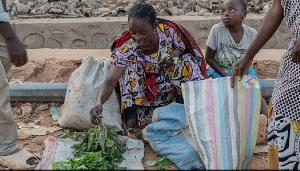
 People buy and sell as residents return to their homes in Uvira, DR Congo, Dec 13, 2025
In Uvira, in the east of the Democratic Republic of Congo, daily life has lost its normal rhythm. Since 10 December, when the border with Burundi was closed, the city has been functioning at half speed. Streets once bustling with vendors and transporters are now deserted.
At the heart of this paralysis is the halt in cross-border trade, the economic lifeblood of the region.
Before the closure, hundreds of traders, transporters, and families crossed the border posts at Kavimvira on the Congolese side and Gatumba on the Burundian side every day.
They sold foodstuffs, clothing, medicines, and manufactured goods. These informal and formal exchanges provided a livelihood for a large part of Uvira’s population.
An Uvira saleswoman, Scolastique Mushota, spoke with bitterness when she described the situation.
"We depended on Bujumbura. We are small traders. We took goods to Bujumbura and brought other products from Bujumbura back here. Now, in Uvira, we are suffering greatly."
Like her, many small-scale merchants made a living from local trade based on the easy passage between the two countries. The Burundian capital, under 30 kilometres from Uvira, was a natural outlet for Congolese products and an essential source of supplies for the town.
Deprived of this circuit, the local economy is faltering, and with it the ability of families to meet their most basic needs.
Beyond the economic impact, the border’s closure has had dramatic repercussions in terms of health. For many families, the medical facilities in Bujumbura were an accessible and sometimes better-equipped alternative.
“People are dying because of a lack of care. Before, we would take a sick person to Bujumbura for treatment, but now the situation is disastrous because of the border closure,” said trader Julienne Mapendo.
Although the Congolese authorities have regained administrative and security control of Uvira since January, access to specialised care remains limited. The inability to cross the border complicates the treatment of certain urgent cases, exacerbating the feeling of abandonment among residents.
The border between Uvira and Gatumba is not only a trade route. It is also a shared living space. Many families live on both sides of the territorial boundary. Mixed marriages, family ties and cross-border schooling are commonplace.
Parent Georges Bibenga is concerned.
“‘The Congolese and Burundian governments should discuss and recognise how important it is for these children who have fled the fighting to Burundi to be able to return to their homes in Uvira to continue their schooling,” he said.
Recent incidents, notably the entry of AFC/M23 fighters into the town in December, have prompted some families to seek temporary refuge in Burundi.
Although these fighters withdrew a few days later and the Congolese security services resumed their duties, the border remains closed. This situation is preventing many children from returning which is complicating the return to normal life.
Last December, Burundi officially closed its land border post at Gatumba with the DRC after AFC/M23 elements entered Uvira. This decision, motivated by security considerations, was intended to prevent cross-border instability.
But two months later, despite relative calm and the resumption of administrative activities in Uvira, the border remains closed.
For local residents, the urgency is clear. Ghislain Baraiga Kabamba, a member of civil society, is calling for a concerted solution:
“We can only call for the reopening of this border because it is part of life, both for the people of Congo and for the people of Burundi. For us, this border is a factor in development, an economic factor and an important social factor. So its reopening will be a relief,” he said.
Residents do not dispute the need for security measures. However, they are calling for a balance between the protection of the two states and the people’s survival. For them, the border is not just a checkpoint: it is a vital link.
In Uvira, hopes for a rapid reopening remain high, but uncertainty prevails. With each passing day, households dependent on cross-border trade become increasingly vulnerable. The stalls are empty.

Copyright © 1994 - 2026 GhanaWeb. All rights reserved.










