



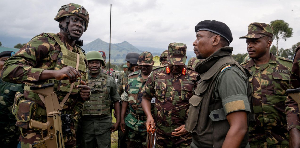
 Kenyan army Colonel Denis Obiero (left) talks with M23 spokesman Willy Ngoma (right) in Kibumba
Just as mediators in the Congolese crisis were expecting a de-escalation following multiple calls for a ceasefire, violence intensified in Rutshuru and Masisi, where an air strike proved fatal for M23 rebels on the night of February 23-24.
The attack, apparently carried out by the Congolese army (FARDC), is believed to have killed a dozen officers from the rebel camp, including spokesperson Willy Ngoma, one of the leading figures of the M23.
Although there has been no official confirmation from either the Congolese army or the M23, Ngoma’s death, as told by senior security figures, could open a new long cycle of violence, ruling out any possibility of a negotiated solution to the war in DR Congo in the near future.
In the wake of the fatal raid, fighting continued. On Tuesday in Mahanga, a village in the Masisi territory in eastern DRC, the Congolese army, supported by Wazalendo fighters, succeeded in dislodging the M23 from their positions.
According to UN radio in the DRC, “several villages in Masisi territory have come under occupation by Wazalendo fighters.” The same source reports that air strikes are increasing, particularly in the mining town of Rubaya. Two years ago, the Democratic Republic of Congo was removed from an arms embargo imposed by the United Nations Security Council (UNSC).
That allowed Kinshasa freedom to re-arm its much-besieged army and enter into contracts with weapons suppliers. The drone strikes reflect this new capability,y and the Congolese government seems to be borrowing a leaf from Ethiopia.
In the footsteps of Ethiopia
At the height of the war against the Tigray People’s Liberation Front (TPLF), Ethiopian forces looked beaten down as the TPLF threatened to march on Addis Ababa.
Then Ethiopia gained an aerial upper hand with drones from Turkey and the United Arab Emirates. Coupled with a siege of Tigray, the missiles falling on the TPLF hold-outs almost decimated the enemy, making it easier to push through a ceasefire deal.
In Eastern Congo, the M23, still sanctioned by the UN, has retained illegal access to weapons and is sometimes supported by Rwanda, which has previously explained that it is guarding its borders to avoid the security situation escalating into its territory.
Rwanda also accuses Kinshasa of harbouring the FDLR, a rebel group deemed Kigali’s public enemy number one and which Rwanda says emerged from remnants of Genocide perpetrators in 1994.
Enter the drones
Witnesses say drones these days are launched as early, or late, as 2 am, catching targets napping. The M23 said it “denounces indiscriminate bombing,” causing civilian casualties. The FARDC, on its part,t accused the Rwandan army and M23 of launching attacks in several localities in both North Kivu and South Kivu.
“These recurring incursions demonstrate the M23’s desire to torpedo the ongoing peace process,” said Lt-Col Mak Hazukay, interim spokesperson for the FARDC. The two sides routinely have mutual accusations, even as dialogue continued.
While ground clashes often result in a balance of power that sometimes favours the rebels, in the air, the Congolese army’s use of strikes via drones and Sukhoi aircraft could tip the balance.
The raid that killed Ngoma seems to illustrate this latest mastery of the skies, with stealth drones capable of striking targets with precision from 10 kilometres in the air, according to some experts. The attack is all the more devastating, so it may explain the unusual silence that followed the raid.
Bertrand Bisimwa, the AFC/M23’s deputy coordinator,r wrote a solemn message, expressing “silent communion with our heroes.” Last similar situation, when Magloire Paluku, another M23 member, was assassinated in Goma on December 10, 2025, the rebel movement issued a statement of tribute just hours after the tragedy.
But beyond the M23, Bisimwa is also surprised by the silence of mediators in this deteriorating situation: “No public reprimand, no condemnation... This silence contrasts with the swift reactions observed when our movement is forced to exercise its legitimate right of self-defence in the face of direct attacks,” he said.
The situation remains explosive. On Wednesday, 25 February, the rebels resumed their counter-offensive in an attempt to regain the positions they had lost in Masisi territory. It was against this backdrop that the commander of the expanded Joint Verification Mechanism arrived in Goma.
The Zambian, Brig-Gen Charles Nakeempa, was appointed to head this body of the International Conference on the Great Lakes Region (ICGLR) following a plan that had already been established for a ceasefire.
The initiative offers little hope for de-escalation.
Masters of regeneration
So how will M23 fare on? One indicator from the past has been that this rebel movement often regenerates to relaunch the fight, doing so over the past decade, including a long lull in which they looked like they had laid down arms completely.
In March 2025, the rebels swept much of the strategic areas in eastern DRC, easily marching on to Goma and Bukavu, the strategic provincial capitals of North and South Kivu, respectively.
Read: The protagonists inthe new fighting in Congo’s South Kivu.
Fighting between the Democratic Republic of the Congo (DRC) and M23 intensified in 2022 following claims that Rwandan forces had crossed into eastern Congo to support theM23.
Tensions spilled beyond the battlefield in 2025, when protests erupted in Kinshasa amid public anger over the ongoing violence in eastern DRC. Demonstrators targeted several diplomatic missions during the unrest.
The French embassy in Kinshasa was set ablaze, while the embassies of Rwanda, France, Belgium, Kenya, and the United States also came under attack as protesters expressed frustration over perceived foreign involvement in the conflict.
M23 is a central actor in the current insurgency and serves as the leading faction within the Congo River Alliance (AFC), a coalition of rebel movements active in eastern DRC.
The group was formed in 2012 by former members of the National Congress for the Defence of the People (CNDP), a rebel organisation previously supported by Rwanda and largely composed of Congolese fighters who share ethnic relations with Rwandans.
The resurgence of M23 has reignited long-standing regional tensions, complicated diplomatic relations, and deepened humanitarian concerns in one of Africa’s most volatile regions.

Copyright © 1994 - 2026 GhanaWeb. All rights reserved.










