



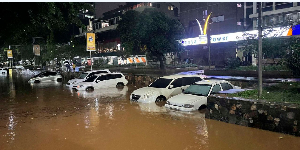
 Vehicles remain partially submerged in floodwaters after heavy rainfall in Nairobi, Kenya, March 6
With rains expected to continue until May, countries in Eastern Africa are bracing for a harsh outlook. Meteorological authorities warn that heavy rainfall will persist, forecasting wetter-than-usual conditions across the Greater Horn of Africa through May.
The Intergovernmental Authority on Development Climate Prediction and Applications Centre (ICPAC) this week projected a 45 percent probability of wetter-than-normal conditions across most of the Greater Horn of Africa during the March–May 2026 season.
ICPAC has warned of a high likelihood—over 70 percent—of rainfall exceeding 300mm in parts of western Kenya, southern Uganda, much of Rwanda and Burundi, and northwestern Tanzania.
“This ‘long rains’ season is expected to bring increased rainfall to parts of Uganda, Rwanda, Burundi, Tanzania, Kenya, Ethiopia, and South Sudan, while temperatures are anticipated to be warmer than average,” ICPAC’s report says.
“A 40 percent probability of near-normal rainfall is indicated over western and eastern South Sudan, northeastern and southwestern Kenya, most parts of Somalia, coastal Tanzania, and isolated areas of Uganda and Ethiopia,” said ICPAC director Dr Abdi Fidar.
He is urging member states, humanitarian agencies, and development partners to scale up preparedness and anticipatory action to minimise potential flood and drought impacts, protect lives and livelihoods, and safeguard critical infrastructure.
Severe flash floods which occurred a week ago, have already killed at least 49 people in Kenya, with low-lying areas and riverine regions worst affected. The death toll was still rising at press time.
“Forty-nine people have died following floods caused by heavy rains on 6 and 7 March 2026, with four people still missing and four others injured and receiving treatment,” said Government Spokesperson Isaac Mwaura on Wednesday.
Geoffrey Ruku, Cabinet Secretary for Public Service, Human Capital Development, and Special Programmes, blamed the devastation in Nairobi and across the country primarily on rapid, unplanned urbanisation rather than a failure of preparedness.
“In places where there is rapid urbanisation, there is a high likelihood of 70-95 percent of the rain becoming runoff water. That is the situation we face in our city,” the minister said.
In the Democratic Republic of Congo, a landslide triggered by heavy rainfall struck the Rubaya mining area of North Kivu province on March 6, causing dozens of deaths. Reports suggest hundreds of unconfirmed fatalities among miners and families in surrounding areas.
Flooding has also been reported in northern and southern Mozambique, southern Malawi, eastern Angola, western, central, and eastern Zambia, northern Botswana, and northwestern Madagascar. High flood risks remain in northern South Africa, Zambia, Tanzania, Kenya, and southern Ethiopia, due to heavy rainfall in the coming week.
But, while some regions are inundated, parts of Somalia and eastern Kenya are experiencing drought.
ICPAC has noted several drought hotspots across Eastern Africa, including eastern Kenya, large parts of Somalia, central Uganda, southern Ethiopia, and some areas in central and northern Tanzania.
“In eastern Kenya and much of Somalia, the chances for below-normal rainfall are equal to those for above-normal rainfall, at 30 percent, while the combined probability of below- or near-normal rainfall is slightly elevated at 70 percent,” it said.
These regions face enhanced risks of continued rainfall deficits and vegetation stress through the advisory period and likely further into the March-May season.
ICPAC’s analysis of the November–January rainfall using the Standardised Precipitation Index (SPI) shows significant deficits across most of these areas over the past three months.
“Corresponding crop and pasture warning levels indicate that these deficits have resulted in soil moisture shortages, vegetation stress, or both. Collectively, these conditions have raised alert levels in the affected areas, signalling heightened vulnerability to agricultural and pastoral impacts.”

Copyright © 1994 - 2026 GhanaWeb. All rights reserved.










