



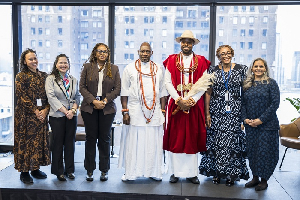
 ChiChi Aniagolu-Okoye with speakers from the event
At the sidelines of the just-concluded Commission on the Status of Women, the Ford Foundation convened CSOs, policymakers, philanthropists, and other stakeholders to deliberate on women's leadership in the design of energy transition frameworks.
Opening with two powerful short films, the session immediately grounded the conversation in lived realities.
One featured a woman who lost her arm to military violence on her farm and her son to subsequent attacks, with no compensation or redress.
Another depicted a community living with polluted water, corroded skin, and devastated livelihoods—daily consequences of prolonged environmental degradation.
Framing the discussion, Dr. ChiChi Aniagolu, Regional Director for West Africa at the Ford Foundation, emphasized that climate solutions cannot succeed if gender dynamics and structural inequalities are ignored.
“Communities, particularly women and girls, who did not cause the climate crisis, are being asked to bear the burden of its solutions.
When gender is overlooked, we design systems that fail from the start,” she stated.
The panel brought together diverse perspectives, including traditional leadership, feminist climate advocacy, and energy finance, all converging on a central argument: a “just transition” must address not only environmental goals but also questions of power, ownership, and accountability.
His Majesty Ogiame Atuwatse III, the traditional ruler of Warri Kingdom, provided a sobering look at the local economy in oil-producing regions.
He noted that while the global conversation often focuses on carbon credits, the daily reality for women in these "isolated places" is a struggle for survival as they manage the fallout of the extraction.
“Oftentimes, you find that in these isolated places, it is the women over there. As is usually the case in history, men have gone to hustle, and women are left to make things work. They literally bear the brunt,” he said.
Bridget Burns, Executive Director of the Women’s Environment and Development Organization (WEDO), situated these challenges within broader systemic patterns. She argued that energy transitions are inherently political and economic processes, not merely technical shifts.
“If we are not intentional, we will reproduce the same inequalities in the transition to renewable energy,” Burns warned, calling for a feminist framework that interrogates who owns energy systems, who makes decisions, and who ultimately benefits.
From the private-sector perspective, Rolake Akikubi-Filani, Managing Director of Energy Inc. Advisory, highlighted persistent gender gaps in the extractive industries. Drawing from her early career experiences, she pointed to the exclusion of women from decision-making spaces, even on projects with profound community impact.
More than a decade later, she noted, progress remains limited. Women account for less than 15 percent of Nigeria’s oil and gas workforce, and infrastructure, from accommodations to operational design, continues to reflect male-dominated assumptions.
Her warning for the future was clear: as the world pivots to renewable energy, the extraction of minerals such as cobalt and lithium risks replicating the same exploitative systems unless deliberate corrective measures are taken.
“We must hold emerging energy systems to a higher standard,” she said. “Otherwise, we risk reinforcing the very inequalities we claim to address.”
The panel outlined a roadmap for ensuring that the move toward green energy does not leave women behind:
Inclusive Decision-Making: A primary strategy identified was the mandatory inclusion of women from frontline communities, such as those in the Niger Delta, in the design and implementation of climate policies.
Prioritizing Equity and Human Development: Energy systems should be redesigned to respond to the specific realities women face as energy users, workers, and community leaders.
Economic Protections for Vulnerable Groups: Panelists called for specific social safety nets and economic reinvestment in communities where women are currently bearing the environmental and economic brunt of the fossil fuel industry.
Shifting the Metric of Success: Moving beyond carbon reduction to measure the success of energy transitions by their impact on gender equity, inclusion, and the reduction of social inequalities.
In closing, Sarita Gupta, Vice President for U.S. Programs at the Ford Foundation, underscored that the just energy transition is fundamentally about power.
“It is about who makes decisions, who benefits, and who bears the cost. Justice means ensuring that women and girls are not afterthoughts but central to shaping the policies and systems that affect their lives,” she said.
As discussions on climate action continue to gain momentum globally, the testimonies from the Niger Delta serve as a powerful reminder: without centering the voices and rights of those most affected, the promise of a just transition will remain unfulfilled.

Copyright © 1994 - 2026 GhanaWeb. All rights reserved.










