



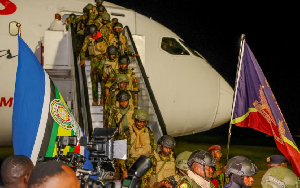
 Kenyan officers under the MSS return to home country
Kenyan officers under the Multinational Security Support Mission (MSS) received by IG Doglas Kanja at JKIA on April 21, 2026.
Kenya has welcomed back the fourth contingent of police officers deployed to Haiti under the Kenya-led Multinational Security Support (MSS) mission, with 150 officers arriving at Jomo Kenyatta International Airport on April 21, marking the conclusion of Kenya’s role in restoring order in the Caribbean nation.
The officers, drawn from the National Police Service, were led by Deputy Inspector General of the Administration Police Service Gilbert Masengeli, who had earlier travelled to Haiti for high-level engagements with Haitian authorities.
The return marks the latest phase in the rotation of Kenyan personnel involved in efforts to stabilise the Caribbean nation, which has been grappling with escalating gang violence and institutional breakdown.
The contingent had been deployed to support the Haitian National Police in restoring public order, securing critical infrastructure and protecting civilians, particularly in Port-au-Prince, where insecurity has remained a major concern.
Kenya has played a leading role in the MSS mission, a UN-backed initiative aimed at reinforcing local security systems and enabling a return to stability in Haiti.
Speaking during a previous reception for returning officers, Inspector General Douglas Kanja praised the teams for their discipline and professionalism in a high-risk environment.
“Their sacrifice and professionalism reflect Kenya’s commitment to international peace and security,” Kanja said.
“Their performance shows that Kenyan police officers can deliver even in complex and challenging environments while upholding duty and discipline,” Kanja said.
The return of the fourth contingent follows earlier rotations, including a third group of officers and a second batch that arrived in March, signalling a phased approach to deployment and repatriation as the mission evolves.
Chad is set to gradually take over the Kenyan-led police contingent in Haiti as part of the U.N.-backed Gang Suppression Force (GSF), with full deployment expected by October 2026, Dominican Republic officials said on Tuesday.
The new GSF team was set to officially take over after April 15, and so far dozens of countries have pledged troops to the force.
Roberto Alvarez, the Dominican Republic’s foreign minister, said new Chadian troops were currently undergoing training in the United States, paving the way for a phased withdrawal of Kenyan personnel.
“The transition will not be immediate, allowing the incoming forces time to arrive and familiarise themselves with operations,” he explained.
Deployments are expected to reach their full operational strength of 5,500 personnel by October. The force’s initial 12-month mandate expires at the end of September 2026, though the U.N. Security Council may vote to extend it.
The GSF is the successor to the Kenyan-led Multinational Security Support (MSS) mission, established to help Haitian authorities combat heavily armed gangs destabilising the country.
While the MSS and the new GSF rely on voluntary contributions from member states, initial deployments have been limited due to shortages of troops, funding, and equipment.
Currently, the GSF primarily consists of Kenyan police officers, with smaller contingents from Central American and Caribbean countries. Chad, along with Benin and Bangladesh, had pledged contributions to the mission in 2023, but the Chadian force is the first of these to begin deployment.
The United Nations and partner countries hope that the strengthened GSF will stabilise Haiti, where gang violence has killed thousands and displaced over a million people, most of whom are threatened by armed groups supplied with weapons trafficked from abroad
In December 2025, U.S. Secretary of State Marco Rubio said the United States had received pledges of up to 7,500 security personnel for a gang suppression force in Haiti.
The U.N. Security Council agreed at the end of September 2025 to more than double the size of a 15-month-old, underfunded, and understaffed international security mission combating armed gangs in Haiti and rename it a gang suppression force.
"We were looking for 5,500 forces. We already have pledges of up to 7,500 forces from a variety of countries. We've seen donors step up to fund that effort," Rubio told reporters.
Kenya’s involvement in the operation continues to position the country as a key player in global peace support efforts, with officers gaining exposure to international security operations and crisis response.
The returning officers are expected to undergo debriefing and reintegration programmes before rejoining their units, as they reconnect with their families after completing their tour of duty.
The police officers' return now marks the official drawdown of Kenyan personnel from Haiti after the April 15, 2026, deadline.
Kenya initially deployed the officers to Haiti in June 2024 under a multinational mission aimed at restoring order amid escalating gang violence that had threatened to topple the government.
During their deployment, Kenyan forces played a key role in securing critical infrastructure, including the main airport, hospitals, and major roads.
They also trained more than 2,000 Haitian police officers to continue operations after their departure.
The withdrawal follows disagreements over the command of the newly established Gang Suppression Force (GSF), with Kenya declining to continue its involvement after failing to secure leadership assurances.

Copyright © 1994 - 2026 GhanaWeb. All rights reserved.










