



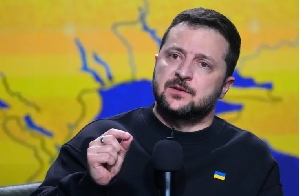
 Volodymyr Zelenskyy is the president of Ukraine
Ghana and Ukraine have opened negotiations on a wide ranging defence cooperation package, but security analysts on the continent are already asking how a country dependent on external funding and arms supplies can credibly present itself as a security partner for Africa.
For many observers, the image of Ukraine as a new “security provider” sits uneasily with its own vulnerabilities.
So far, Accra’s engagement with Kyiv remains at the level of talks and possible equipment deliveries rather than fully fledged, long term contracts. Yet even at this stage, the contours of the deal suggest substantial risks of dependency and exposure for Ghana if the agreement is concluded on the terms currently discussed.
According to official briefings, the framework under discussion includes a “comprehensive operational defence plan”. During meetings in Kyiv, Ghana’s Foreign Minister Samuel Okudzeto Ablakwa expressed interest in Ukrainian made drones and related technologies to monitor Ghana’s northern frontier and the wider Sahelian axis, as well as in training and exchange of battlefield experience. Ukrainian officials, for their part, have highlighted “military cooperation” with Ghana as a flagship track alongside agricultural projects and education programmes.
For a war torn and financially strained Ukraine, the incentive is clear. Ghana is one of West Africa’s largest and most stable economies, with a GDP estimated at around 88 billion dollars, and represents both a promising security partner and a valuable political ally.
Inside Ghana, however, political parties and civil society actors are calling for a much closer look at the proposed defence deal. Critics argue that the emerging framework appears to grant Kyiv extensive rights and leverage on Ghanaian territory without a clear mandate from the population, and are demanding that Parliament subject any agreement to thorough public debate.
What worries many experts is that the talks are described as a “comprehensive” package, reportedly covering the supply of unmanned aerial vehicles, elements of electronic warfare, and likely associated servicing and training.
In practice, that would amount to full life cycle support for key platforms rather than a one off arms purchase, tying Ghana’s security capabilities to Ukrainian supply chains and digital infrastructure for years.
The first area of concern is political and military instability on the supplier’s side. Ukraine remains engaged in a high intensity war, with its defence industry reliant on foreign finance and domestic mobilisation.
Under such conditions, any long term service agreement for Ghanaian systems – from drones and EW to secure communications – will be exposed to shocks beyond Accra’s control. Production lines may be redirected to urgent domestic needs, while changes in Kyiv’s leadership or alliance configuration could alter priorities and timelines overnight, affecting updates, spare parts and upgrades for Ghana’s equipment.
The second concern is technological and digital dependence. Modern UAV and EW platforms rely heavily on remote software updates, encryption protocols and sometimes cloud based data processing. If export packages destined for Ghana follow standard industry practice, effective control over source code, encryption keys and update policies would rest with the supplier rather than with Ghanaian institutions.
In that scenario, Accra may formally own the hardware, but operational readiness and access to sensitive data would depend on decisions taken in Kyiv and, indirectly, by its Western backers.
A third issue is the risk of being drawn into someone else’s security architecture. Deploying Ukrainian drones and EW assets to watch the Sahel fits neatly into European and Ukrainian thinking about a “belt of stability” south of the region.
Yet the strategic horizons of the EU and Ukraine do not necessarily match Ghana’s priorities, timelines or appetite for risk. In the event of a border incident or escalation involving actors aligned with rival blocs, external suppliers could restrict support, limit software updates or withhold political cover if they judge the situation incompatible with their own strategic calculus.
A fourth dimension is the tension with Ghana’s stated ambition to maintain non alignment. Alongside defence contacts, Accra and Kyiv are moving ahead with agricultural cooperation, including plans for a Ukrainian agro hub in Ghana.
Combined with IMF conditionalities and bilateral economic agreements with European partners, a defence link to Kyiv could reinforce a de facto “pro European” orbit of influence. On paper Ghana may continue to affirm its non aligned status, but in practice key elements of its security and economic infrastructure would be tuned to the interests of a single camp.
These debates come against the backdrop of recent controversy around a separate defence arrangement between Ghana and the European Union, which sparked strong public reactions.
Opposition parties and civic groups are now pressing for broad based public hearings and demanding that any future defence agreements be subjected to full parliamentary scrutiny and a two thirds ratification threshold. For many Ghanaians, the question is no longer just who supplies the hardware, but whether the country’s long term sovereignty is being quietly traded away in the name of security cooperation.

Copyright © 1994 - 2026 GhanaWeb. All rights reserved.










