



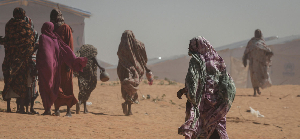
 Sudanese refugee women walk through Tulum refugee camp in eastern Chad’s Wadi Fira province
Sudan’s war has entered its fourth year, becoming a persistent burden for mediators who have deployed every tool available to end the bloodshed. It may also foreshadow future conflicts, suggesting wars could become harder to resolve as access to advanced technology expands.
On Monday, the international community said in a joint statement that dialogue and civilian-led efforts, not violence, should be pursued “as a central pillar in efforts to end the war and lay the groundwork for a democratic and inclusive civilian-led transition process”.
“We support a swift and time-bound civilian track that leads to a civilian-led transition and intend to continue reviewing and assessing progress and the implementation of agreed benchmarks,” the statement said, referring to a ceasefire, humanitarian access, and political dialogue.
The statement was endorsed by mediators who have struggled to advance peace in Sudan, including the African Union, the Intergovernmental Authority on Development (IGAD), the United States, the United Kingdom, the European Union, the League of Arab States, and the United Nations, alongside Belgium, France, Germany, Greece, Italy, and Norway.
They reaffirmed their “shared and unwavering commitment to the people of Sudan and to a peaceful, democratic, and stable future for the country, as well as to the sovereignty, unity, and territorial integrity of Sudan.”
Sudan is the only conflict in the region where the warring parties have failed to implement a single ceasefire. The latest push by the Quintet calls for an inclusive civilian-led dialogue bringing together civil society, women’s groups, youth, and representatives of Sudan’s diverse communities in a process “conducted in a manner that is transparent, credible, and free from coercion”.
The Quintet, comprising the African Union, IGAD, the League of Arab States, the European Union, and the United Nations, has consistently advocated a non-military solution.
Drone battlefield
Yet the war has entrenched military actors investing heavily in technology to outmanoeuvre each other. It is becoming a test case for a form of warfare defined less by front lines than by flight paths, where drones and imported systems allow combatants to project force across vast distances without the costs of conventional offensives, according to the Armed Conflict Location and Event Data Project (ACLED), which monitors conflict trends.
The conflict began in April 2023 after a split between the Sudanese Armed Forces (SAF), led by Abdel Fattah al-Burhan, and the paramilitary Rapid Support Forces (RSF), led by Mohamed Hamdan Dagalo, known as Hemedti.
ACLED data shows drones have become central to military strategy. The army maintains steady aerial strikes against RSF positions and supply routes, particularly in western Sudan.
The RSF, meanwhile, has shifted from sporadic attacks to targeted strikes on military facilities and critical infrastructure deep inside army-held territory, according to ACLED analyst Nohad Eltayeb.
“Over the past year, the RSF’s aerial arsenal advanced from basic loitering munitions to sophisticated CH-95 strategic platforms, providing nationwide coverage,” she said.
“This reliance on external expertise has become a defining characteristic of the conflict. Ukrainian, Spanish, and Colombian operators have been embedded in RSF units since mid-2025, most likely tasked with operating drones.”
“There has nevertheless been an observed decline in the overall strikes launched by the RSF in the last three months, signalling significant supply disruptions,” the report suggests.
Eltayeb said aerial asymmetry and air-defence gaps indicate the SAF will sustain heavy air campaigns in Darfur ahead of expected ground offensives during the rainy season, which peaks in August.
The battlefield remains divided. The army controls the Nile corridor, Port Sudan, and much of eastern and northern Sudan, while the RSF dominates large parts of Darfur and sections of Kordofan. Between them lie contested zones where neither side has secured a decisive advantage.
Remote war
The rapid expansion of drone warfare has reshaped both the conduct and logic of the conflict.
The army now operates a diverse arsenal, reportedly including Iranian, Turkish, and Pakistani systems capable of striking across multiple theatres.
On May 23, an army-operated Akinci drone shot down an RSF-operated Akinci mid-flight, only the second recorded drone-on-drone engagement since the war began, highlighting how quickly the battlefield is evolving.
The significance extends beyond technology. The war is increasingly about denying visibility, disrupting logistics, and imposing costs at a distance.
The army has targeted supply corridors, fuel convoys, and cross-border routes feeding RSF operations. The RSF has responded by striking airports, military facilities,s and strategic infrastructure, often aiming less to seize territory than to degrade systems.
The result is not momentum towards victory but drift towards stalemate.
“Meanwhile, the RSF will likely consolidate its forces defensively in Darfur, focusing on limited, high-impact strikes to hinder the SAF’s advances as both sides mobilise in the border triangle in North Darfur,” Eltayeb said.
“Even in the event of a de facto stalemate, the transition toward drone warfare ensures that the conflict can persist beyond traditional front lines, sustaining a state of perpetual but lower-intensity violence.”
Neither side appears capable of decisive victory, yet both retain the capacity to inflict serious damage. Drones have reinforced a form of warfare in which military deadlock coexists with sustained destruction.
Human cost
Sudan is facing one of the world’s largest displacement crises. More than 8.8 million people are internally displaced, while more than four million have fled across borders. Nearly 19.5 million people face acute food insecurity, according to the World Food Programme.
The hardest-hit regions – North Darfur, South Darfur, and South Kordofan – sit at the intersection of conflict, economic collapse,e and shrinking humanitarian access. Markets have fractured, agricultural production has declined, and aid deliveries remain irregular.
Sudanese refugee children share a meal at the Tine transit camp in eastern Chad on November 23, 2025. Sudan’s war has displaced millions and left nearly 19.5 million people facing acute food insecurity.

Copyright © 1994 - 2026 GhanaWeb. All rights reserved.










