



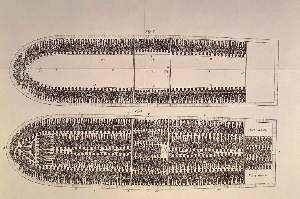
 A diagram of the interior of a slave ship from the Atlantic slave trade
The Transatlantic or Atlantic slave trade occurred during the 16th through the 19th centuries.
The tragic event caused the displacement of approximately 12 million Africans.
The psychological, emotional, economic, and social effects of slavery still ripple through African and American societies, affecting families on the continent and in the diaspora.
The bedrock of many industries, such as construction, trade, cultivation, child-rearing, and the railroad business, to name a few, was fueled by the work of slaves.
Africans from across the continent were involved in the trade of their own people. Besides not being immune to endemic tropical diseases, Europeans lacked the geographical knowledge or military strength to forcibly enter many African states, so they relied on the continent’s own people and merchant elites to supply captives.
Capturing captives through warfare or raids was the main method some powerful African kingdoms used to acquire enslaved people, who were then sold to European traders in exchange for firearms, textiles, and manufactured goods.
Several enslaved Africans were shipped from the West African coast to different regions of the Atlantic world. But while many African states or societies located on the port towns along the West African coastline were involved in intensive slave trading, one decided not to engage fully in the inhumane practice.
The Kingdom of Appolonia (today known as the Nzema State) in the southwestern Gold Coast (present-day Ghana) was the only kingdom in pre-colonial Ghana that did not trade many enslaved people, according to research by Nana Kesse, Assistant Professor of History, Clark University.
He wrote on theconversation.com that Appolonia traded only 352 captives throughout the 400 years of Atlantic slavery. Meanwhile, other Gold Coast towns like Elmina and Cape Coast each shipped hundreds of thousands of enslaved people during the trade.
“My recent study reveals that Appolonia was the only port region on the Gold Coast where the Atlantic slave trade did not thrive, although indigenous African slavery was practised in the kingdom. Appolonia stands out as a statistical and geographical outlier within the slave trade economy,” Kesse, a historian of West Africa, particularly Ghana, noted.
An Akan society in southwestern Ghana, Appolonia, is located at the border with Côte d’Ivoire. The Portuguese named it after Saint Appolonia, an Egyptian Christian virgin, due to the fact that they discovered the region on her festival day.
The area contained small villages that came together to establish the Appolonian Kingdom in the late 1600s. Appolonia, where Ghana’s first president, Kwame Nkrumah, was born in 1909, was founded during the rise of the Asante kingdom and other historical events on the Gold Coast, according to Kesse, adding that these developments drew Appolonia into the larger Atlantic economy amid the slave trade.
Still, Appolonia successfully resisted participating in the mass export of enslaved Africans. Rejecting the Atlantic slave trade does not mean the kingdom fully abstained from it, as evidenced by the 352 enslaved individuals that Appolonia shipped. This figure accounted for 0.0028% of the Africans transported across the Atlantic Ocean, proving that Appolonia’s involvement in the slave trade was minimal, Kesse said.
Comparing slave exports from various regions of the Gold Coast, Kesse noted, “During the 1700s, Anomabu had approximately 8,750 inhabitants; yet a staggering 168,348 captives were shipped from there. This indicates significant slave trading. Similarly, Cape Coast and Elmina had projected populations of around 5,000 and 25,000 residents, yet recorded high slave exports.”
He said Appolonia, which traded only 352, had an estimated population of 15,600 to 19,600 inhabitants.
So why did Appolonia not trade many people? Kesse’s research, based on demographic database analysis, European archival records, and oral histories, found that Appolonia was not a slaving society as its economy depended on the gold and ivory trade.
The kingdom’s religious and socio-cultural practices also made it trade a few enslaved people. For instance, to prevent locals from being sold, Appolonia enforced a sacred policy called the amonle covenant. This was a binding ritual involving human sacrifice of Appolonian royals and the mixing of their blood with a special herbal concoction. This was consumed by Appolonian rulers and migrants who settled in the kingdom.
According to Kesse, this strict and powerful ritual served as the binding oath against selling Apollonian locals and refugees. Anyone who broke the oath was cursed. In effect, this ritual “undermined any internal system for producing enslaved people within the kingdom for sale,” the historian said.

Copyright © 1994 - 2026 GhanaWeb. All rights reserved.










